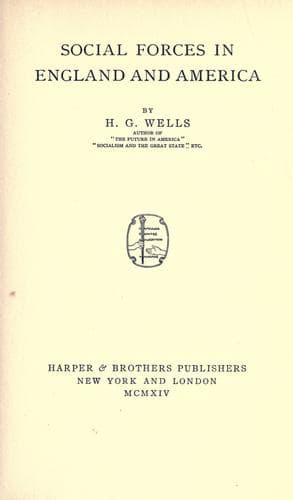
Social Forces in England and AmericaWells, H. G. (Herbert George)
History
Social Forces in England and America
Wells, H. G. (Herbert George)
England -- Social conditions -- 20th century; Social problems; United States -- Social conditions -- 1865-1918
Will the growing idea of a closer social organisation have developed by
that time to the possibility of some collective effort in this matter?
Or will that only come about after the population of the world has
passed through a phase of absolute recession? The peculiar constitution
of the United States gives a remarkable freedom of experiment in these
matters to each individual state, and local developments do not need to
wait upon a national change of opinion; but, on the other hand, the
superficial impression of an English visitor is that any such profound
interference with domestic autonomy runs counter to all that Americans
seem to hold dear at the present time. These are, however, new ideas and
new considerations that have still to be brought adequately before the
national consciousness, and it is quite impossible to calculate how a
population living under changing conditions and with a rising standard
of education and a developing feminine consciousness may not think and
feel and behave in a generation’s time. At present for all political and
collective action America is a democracy of untutored individualist men
who will neither tolerate such interference between themselves and the
women they choose to marry as the Endowment of Motherhood implies, nor
view the “kids” who will at times occur even in the best-regulated
families as anything but rather embarrassing, rather amusing by-products
of the individual affections.
I find in the London _New Age_ for August 15th, 1908, a description by
Mr. Jerome K. Jerome of “John Smith,” the average British voter. John
Smith might serve in some respects for the common man of all the modern
civilisations. Among other things that John Smith thinks and wants, he
wants:
“a little house and garden in the country all to himself. His idea
is somewhere near half an acre of ground. He would like a piano in
the best room; it has always been his dream to have a piano. The
youngest girl, he is convinced, is musical. As a man who has knocked
about the world and has thought, he quite appreciates the argument
that by co-operation the material side of life can be greatly
improved. He quite sees that by combining a dozen families together
in one large house better practical results can be obtained. It is
as easy to direct the cooking for a hundred as for half a dozen.
There would be less waste of food, of coals, of lighting. To put
aside one piano for one girl is absurd. He sees all this, but it
does not alter one little bit his passionate craving for that small
house and garden all to himself. He is built that way. He is typical
of a good many other men and women built on the same pattern. What
are you going to do with them? Change them—their instincts, their
very nature, rooted in the centuries? Or, as an alternative, vary
Socialism to fit John Smith? Which is likely to prove the shorter
operation?”
That, however, is by the way. Here is the point at issue:
Public-domain text, read in full here on John Shaqi.
Reviews
Reviews
No reviews yet
Be the first to share your thoughts on this work.
Elsewhere in the archive
Join the Discussion
Join the discussion
Sign in to leave a comment or review.
Sign InorCreate an account