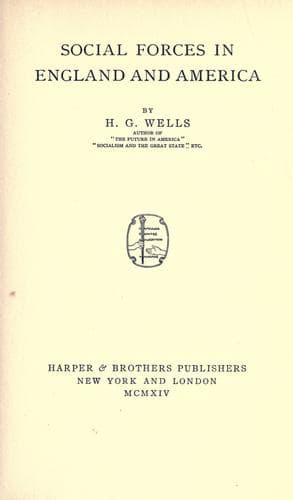
Social Forces in England and AmericaWells, H. G. (Herbert George)
History
Social Forces in England and America
Wells, H. G. (Herbert George)
England -- Social conditions -- 20th century; Social problems; United States -- Social conditions -- 1865-1918
“He has heard that Socialism proposes to acknowledge woman’s service
to the State by paying her a weekly wage according to the number of
children that she bears and rears. I don’t propose to repeat his
objections to the idea; they could hardly be called objections.
There is an ugly look comes into his eyes; something quite
undefinable, prehistoric, almost dangerous, looks out of them.... In
talking to him on this subject you do not seem to be talking to a
man. It is as if you had come face to face with something behind
civilisation, behind humanity, something deeper down still among the
dim beginnings of creation....”
Now, no doubt Mr. Jerome is writing with emphasis here. But there is
sufficient truth in the passage for it to stand here as a rough symbol
of another factor in this question. John Smithism, that manly and
individualist element in the citizen, stands over against and resists
all the forces of organisation that would subjugate it to a collective
purpose. It is careless of coming national cessation and depopulation,
careless of the insurgent spirit beneath the acquiescences of Mrs.
Smith, careless of its own inevitable defeat in the economic struggle,
careless because it can understand none of these things; it is
obstinately muddle-headed, asserting what it conceives to be itself
against the universe and all other John Smiths whatsoever. It is a
factor with all other factors. The creative, acquisitive, aggressive
spirit of those bigger John Smiths who succeed as against the myriads of
John Smiths who fail, the wider horizons and more efficient methods of
the educated man, the awakening class-consciousness of women, the
inevitable futility of John Smithism, the sturdy independence that makes
John Smith resent even disciplined co-operation with Tom Brown to
achieve a common end, his essential incapacity, indeed, for collective
action; all these things are against the ultimate triumph, and make for
the ultimate civilisation even of John Smith.
§ 11
It may be doubted if the increasing collective organisation of society
to which the United States of America, in common with all the rest of
the world, seem to be tending will be to any very large extent a
national organisation. The constitution is an immense and complicated
barrier to effectual centralisation. There are many reasons for
supposing the national government will always remain a little
ineffectual and detached from the full flow of American life, and this
notwithstanding the very great powers with which the President is
endowed.
Public-domain text, read in full here on John Shaqi.
Reviews
Reviews
No reviews yet
Be the first to share your thoughts on this work.
Elsewhere in the archive
Join the Discussion
Join the discussion
Sign in to leave a comment or review.
Sign InorCreate an account