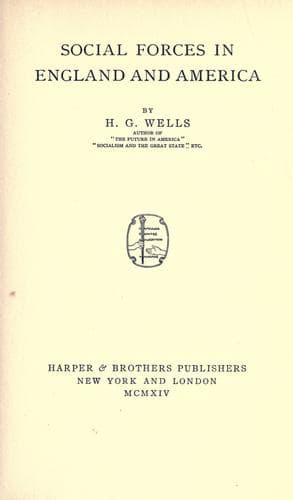
Social Forces in England and AmericaWells, H. G. (Herbert George)
History
Social Forces in England and America
Wells, H. G. (Herbert George)
England -- Social conditions -- 20th century; Social problems; United States -- Social conditions -- 1865-1918
It does very greatly help in this question to bear in mind the conflict
of our origins. Every age is an age of transition, of minglings, of the
breaking up of old, narrow cultures, and the breaking down of barriers,
of spiritual and often of actual interbreeding. Not only is the physical
but the moral and intellectual ancestry of everyone more mixed than ever
it was before. We blend in our blood, every one of us, and we blend in
our ideas and purposes, craftsmen, warriors, savages, peasants, and a
score of races, and an endless multitude of social expedients and rules.
Go back but a hundred generations in the lineage of the most delicate
girl you know, and you will find a dozen murderers. You will find liars
and cheats, lascivious sinners, women who have sold themselves, slaves,
imbeciles, devotees, saints, men of fantastic courage, discreet and
watchful persons, usurers, savages, criminals and kings, and every one
of this miscellany, not simply fathering or mothering on the way to her,
but teaching urgently and with every grade of intensity, views and
habits for which they stand. Something of it all has come to her, albeit
much may seem forgotten. In every human birth, with a new little
variation, a fresh slight novelty of arrangement, the old issues rise
again. Our ideas, even more than our blood, flow from multitudinous
sources.
Certain groups of ideas come to us distinctively associated with certain
marked ways of life. Many, and for a majority of us, it may be, most of
our ancestors were serfs or slaves. And men and women who have had,
generation after generation, to adapt themselves to slavery and the rule
of a master, develop an idea of goodness very different from that of
princes. From our slave ancestry, says Lester Ward, we learnt to work,
and certainly it is from slavery we derive the conception that industry,
even though it be purposeless industry, is a virtue in itself. The good
slave, too, has a morality of restraints; he abstains from the food he
handles and hungers for, and he denies himself pride and initiative of
every sort. He is honest in not taking, but he is unscrupulous about
adequate service. He makes no virtue of frankness, but much of kindly
helpfulness and charity to the weak. He has no sense of duty in planning
or economising. He is polite and soft-spoken, and disposed to irony
rather than denunciation, ready to admire cuteness and condone
deception. Not so the rebel. That tradition is working in us also. It
has been the lot of vast masses of population in every age to be living
in successful or unsuccessful resistance to mastery, to be dreading
oppression or to be just escaped from it. Resentment becomes a virtue
then, and any peace with the oppressor a crime. It is from rebel origins
so many of us get the idea that disrespectfulness is something of a duty
and obstinacy a fine thing. And under the force of this tradition we
idealise the rugged and unmanageable, we find something heroic in rough
Public-domain text, read in full here on John Shaqi.
Reviews
Reviews
No reviews yet
Be the first to share your thoughts on this work.
Elsewhere in the archive
Join the Discussion
Join the discussion
Sign in to leave a comment or review.
Sign InorCreate an account