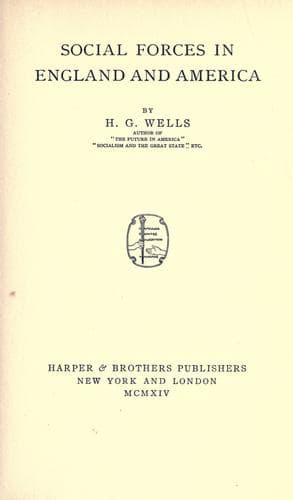
Social Forces in England and AmericaWells, H. G. (Herbert George)
History
Social Forces in England and America
Wells, H. G. (Herbert George)
England -- Social conditions -- 20th century; Social problems; United States -- Social conditions -- 1865-1918
clothes and hands, in bad manners, insensitive behaviour, and
unsociableness. And a community of settlers, again, in a rough country,
fighting for a bare existence, makes a virtue of vehemence, of a hasty
rapidity of execution. Hurried and driven men glorify “push” and
impatience, and despise finish and fine discrimination as weak and
demoralising things. These three, the Serf, the Rebel, and the Squatter,
are three out of a thousand types and aspects that have gone to our
making. In the American composition they are dominant. But all those
thousand different standards and traditions are our material, each with
something fine, and each with something evil. They have all provided the
atmosphere of upbringing for men in the past. Out of them and out of
unprecedented occasions, we in this newer age, in which there are no
slaves, in which every man is a citizen, in which the conveniences of a
great and growing civilisation make the frantic avidity of the squatter
a nuisance, have to set ourselves to frame the standard of our
children’s children, to abandon what the slave or the squatter or the
rebel found necessary and that we find unnecessary, to fit fresh
requirements to our new needs. So we have to develop our figure of the
fine man, our desirable citizen in that great and noble civilised state
we who have a “sense of the state” would build out of the confusions of
our world.
To describe that ideal modern citizen now is at best to make a guess and
a suggestion of what must be built in reality by the efforts of a
thousand minds. But he will be a very different creature from that
indifferent, well-behaved business man who passes for a good citizen
to-day. He will be neither under the slave tradition nor a rebel nor a
vehement elemental man. Essentially he will be aristocratic,
aristocratic not in the sense that he has slaves or class inferiors,
because probably he will have nothing of the sort, but aristocratic in
the sense that he will feel the State belongs to him and he to the
State. He will probably be a public servant; at any rate, he will be a
man doing some work in the complicated machinery of the modern community
for a salary and not for speculative gain. Typically, he will be a
professional man. I do not think the ideal modern citizen can be a
person living chiefly by buying for as little as he can give and selling
for as much as he can get; indeed, most of what we idolise to-day as
business enterprise I think he will regard with considerable contempt.
But, then, I am a Socialist, and look forward to the time when the
economic machinery of the community will be a field not for private
enrichment but for public service.
Public-domain text, read in full here on John Shaqi.
Reviews
Reviews
No reviews yet
Be the first to share your thoughts on this work.
Elsewhere in the archive
Join the Discussion
Join the discussion
Sign in to leave a comment or review.
Sign InorCreate an account