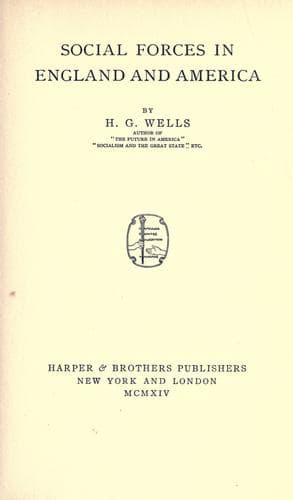
Social Forces in England and AmericaWells, H. G. (Herbert George)
History
Social Forces in England and America
Wells, H. G. (Herbert George)
England -- Social conditions -- 20th century; Social problems; United States -- Social conditions -- 1865-1918
But these are the mere opening requirements of this hope of mine of a
quickened social consciousness among the more fortunate and leisurely
section of the community. I believe that much profounder changes in the
conditions of labour are possible than those I have suggested. I am
beginning to suspect that scarcely any of our preconceptions about the
way work must be done, about the hours of work and the habits of work,
will stand an exhaustive scientific analysis. It is at least conceivable
that we could get much of the work that has to be done to keep our
community going in far more toil-saving and life-saving ways than we
follow at the present time. So far scientific men have done scarcely
anything to estimate under what conditions a man works best, does most
work, works more happily. Suppose it turns out to be the case that a man
always following one occupation throughout his lifetime, working
regularly day after day for so many hours, as most wage-earners do at
the present time, does not do nearly so much or nearly so well as he
would do if he followed first one occupation and then another, or if he
worked as hard as he possibly could for a definite period and then took
holiday? I suspect very strongly, indeed I am convinced, that in certain
occupations, teaching, for example, or surgery, a man begins by working
clumsily and awkwardly, that his interest and skill rise rapidly, that
if he is really well suited in his profession, he may presently become
intensely interested and capable of enormous quantities of his very best
work, and that then his interest and vigour rapidly decline. I am
disposed to believe that this is true of most occupations, of coal
mining or engineering, or bricklaying or cotton-spinning. The thing has
never been properly thought about. Our civilisation has grown up in a
haphazard kind of way, and it has been convenient to specialise workers
and employ them piecemeal. But if it is true that in respect of any
occupation a man has his period of maximum efficiency, then we open up a
whole world of new social possibilities. What we really want from a man
for our social welfare in that case is not regular continuing work, but
a few strenuous years of high-pressure service. We can as a community
afford to keep him longer at education and training before he begins,
and we can release him with a pension while he is still full of life and
the capacity for enjoying freedom. But obviously this is impossible upon
any basis of weekly wages and intermittent employment; we must be
handling affairs in some much more comprehensive way than that before we
can take and deal with the working life of a man as one complete whole.
Public-domain text, read in full here on John Shaqi.
Reviews
Reviews
No reviews yet
Be the first to share your thoughts on this work.
Join the Discussion
Join the discussion
Sign in to leave a comment or review.
Sign InorCreate an account