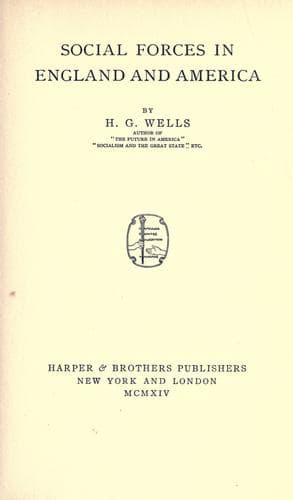
Social Forces in England and AmericaWells, H. G. (Herbert George)
History
Social Forces in England and America
Wells, H. G. (Herbert George)
England -- Social conditions -- 20th century; Social problems; United States -- Social conditions -- 1865-1918
Now that, I admit, is, as the Americans say, a large proposition. But we
are living in a time of more and more comprehensive plans, and the mere
fact that no scheme so extensive has ever been tried before is no reason
at all why we should not consider one. We think nowadays quite serenely
of schemes for the treatment of the nation’s health as one whole, where
our fathers considered illness as a blend of accident with special
providences; we have systematised the community’s water supply,
education, and all sorts of once chaotic services, and Germany and our
own infinite higgledy-piggledy discomfort and ugliness have brought home
to us at last even the possibility of planning the extension of our
towns and cities. It is only another step upward in scale to plan out
new, more tolerable conditions of employment for every sort of worker
and to organise the transition from our present disorder.
The essential difficulty between the employer and the statesman in the
consideration of this problem is the difference in the scope of their
view. The employer’s concern with the man who does his work is day-long
or week-long; the statesman’s is life-long. The conditions of private
enterprise and modern competition oblige the employer to think only of
the worker as a hand, who appears and does his work and draws his wages
and vanishes again. Only such strikes as we have had during the past
year will rouse him from that attitude of mind. The statesman at the
other extremity has to consider the worker as a being with a beginning,
a middle, an end—and offspring. He can consider all these possibilities
of deferring employment and making the toil of one period of life
provide for the leisure and freedom of another, which are necessarily
entirely out of the purview of an employer pure and simple. And I find
it hard to see how we can reconcile the intermittency of competitive
employment with the unremitting demands of a civilised life except by
the intervention of the State or of some public organisation capable of
taking very wide views between the business organiser on the one hand
and the subordinate worker on the other. On the one hand we need some
broader handling of business than is possible in the private adventure
of the solitary proprietor or the single company, and on the other some
more completely organised development of the collective bargain. We have
to bring the directive intelligence of a concern into an organic
relation with the conception of the national output as a whole, and
either through a trade union or a guild, or some expansion of a trade
union, we have to arrange a secure, continuous income for the worker, to
be received not directly as wages from an employer, but intermediately
through the organisation. We need a census of our national production, a
more exhaustive estimate of our resources, and an entirely more
scientific knowledge of the conditions of maximum labour efficiency. One
turns to the State....
Public-domain text, read in full here on John Shaqi.
Reviews
Reviews
No reviews yet
Be the first to share your thoughts on this work.
Join the Discussion
Join the discussion
Sign in to leave a comment or review.
Sign InorCreate an account