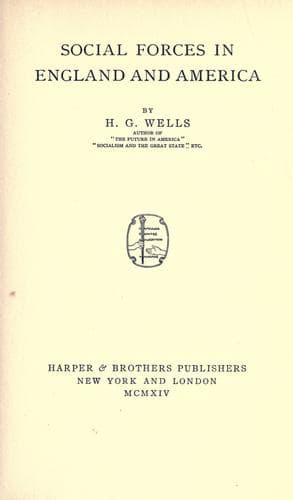
Social Forces in England and AmericaWells, H. G. (Herbert George)
History
Social Forces in England and America
Wells, H. G. (Herbert George)
England -- Social conditions -- 20th century; Social problems; United States -- Social conditions -- 1865-1918
Hitherto my only flights have been flights of imagination, but this
morning I flew. I spent about ten or fifteen minutes in the air; we went
out to sea, soared up, came back over the land, circled higher, planed
steeply down to the water, and I landed with the conviction that I had
had only the foretaste of a great store of hitherto unsuspected
pleasures. At the first chance I will go up again, and I will go higher
and further.
This experience has restored all the keenness of my ancient interest in
flying, which had become a little fagged and flat by too much hearing
and reading about the thing and not enough participation. Sixteen years
ago, in the days of Langley and Lilienthal, I was one of the few
journalists who believed and wrote that flying was possible; it affected
my reputation unfavourably, and produced in the few discouraged pioneers
of those days a quite touching gratitude. Over my mantel as I write
hangs a very blurred and bad but interesting photograph that Professor
Langley sent me sixteen years ago. It shows the flight of the first
piece of human machinery heavier than air that ever kept itself up for
any length of time. It was a model, a little affair that would not have
lifted a cat; it went up in a spiral and came down unsmashed, bringing
back, like Noah’s dove, the promise of tremendous things.
That was only sixteen years ago, and it is amusing to recall how
cautiously even we out-and-out believers did our prophesying. I was
quite a desperate fellow; I said outright that in my lifetime we should
see men flying. But I qualified that by repeating that for many years to
come it would be an enterprise only for quite fantastic daring and
skill. We conjured up stupendous difficulties and risks. I was deeply
impressed and greatly discouraged by a paper a distinguished Cambridge
mathematician produced to show that a flying machine was bound to pitch
fearfully, that as it flew on its pitching _must_ increase until up went
its nose, down went its tail, and it fell like a knife. We exaggerated
every possibility of instability. We imagined that when the aeroplane
wasn’t “kicking up ahind and afore” it would be heeling over to the
lightest side wind. A sneeze might upset it. We contrasted our poor
human equipment with the instinctive balance of a bird, which has had
ten million years of evolution by way of a start....
The waterplane in which I soared over Eastbourne this morning with Mr.
Grahame-White was as steady as a motor-car running on asphalte.
Public-domain text, read in full here on John Shaqi.
Reviews
Reviews
No reviews yet
Be the first to share your thoughts on this work.
Join the Discussion
Join the discussion
Sign in to leave a comment or review.
Sign InorCreate an account