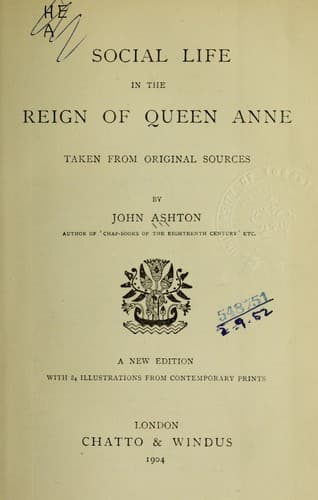
Social Life in the Reign of Queen Anne, Taken from Original SourcesAshton, John
History
Social Life in the Reign of Queen Anne, Taken from Original Sources
Ashton, John
Great Britain -- History -- Anne, 1702-1714; Great Britain -- Social life and customs -- 18th century
Booth was the Aristo of the profession. He was not only nearly related
to the Earl of Warrington, but in 1704 he married a daughter of Sir
William Barkham, Bart., of Norfolk. A scholar of the great and
terrible Dr. Busby, he shone in acting in the Latin plays at
Westminster. He was intended for the Church, but he caught stage
fever, ran away from school at the age of 17, and joined the theatre
at Dublin. When he came to London he became a pupil of Betterton's,
and profited by his master's instructions. He was joint patentee in
Drury Lane, but he left the stage at the early age of 46. Died 1733.
Of the minor actors Pinkethman stands first. He was low comedy, and
his great ambition was to please the gods. We have heard a good deal
about him in this book in his various characters as caterer for the
amusement of the public. Gildon, of course, can say nothing good of
him.
_Sullen._ But Penkethman the flower of----
_Critick._ Bartholomew Fair, and the idol of the rabble; a fellow
that over does everything, and spoils many a part with his own
stuff.
Be this as it may, he is very honourably mentioned throughout the
_Spectator_, although Steele[454] gives him a good-humoured rap over
the knuckles. 'Mr. William Bullock and Mr. William Penkethman are of
the same Age, Profession, and Sex. They both distinguish themselves in
a very particular Manner under the discipline of the Crab-tree, with
this only difference, that Mr. Bullock has the more agreeable Squall,
and Mr. Penkethman the more graceful Shrug. Penkethman devours a cold
Chick with great Applause; Bullock's talent lies chiefly in Asparagus.
Penkethman is very dexterous at conveying himself under a Table;
Bullock is no less active in jumping over a Stick. Penkethman has a
great deal of money; but Mr. Bullock is the taller man.'
[Footnote 454: _Tatler_, 188.]
The mention of Crab-tree seems to suggest that Pinkethman had been
thrashed at some period of his career, as does a passage in another
_Tatler_ (No. 42), describing the theatrical properties at Drury Lane:
'Three oak Cudgels, with one of Crab-tree; all bought for the Use of
Mr. Pinkethman.'
That he must have been a fair actor is testified by the fact that he
played in two out of the four performances at St. James's.
As far as I can find out, he seems first to have acted at the Theatre
Royal in 1692, in the play of 'Volunteers, or the Stock Jobbers,'[455]
when he played the part of Taylor (six lines only). He rose gradually,
and was a painstaking actor, ever on the alert to court popular
favour. He became rich. Downes says of him, 'He's the darling of
_Fortunatus_, he has gain'd more in Theatres and Fairs in Twelve Years
than those that have Tugg'd at the Oar of Acting these 50.' To realise
this fortune he probably was saving in his habits, and not so lavish
as some of his compeers--a fact which is exaggerated into a charge of
meanness: see an Elegy on his Merry Andrew, John Edwards.[456]
Public-domain text, read in full here on John Shaqi.
Reviews
Reviews
No reviews yet
Be the first to share your thoughts on this work.
Elsewhere in the archive
Join the Discussion
Join the discussion
Sign in to leave a comment or review.
Sign InorCreate an account