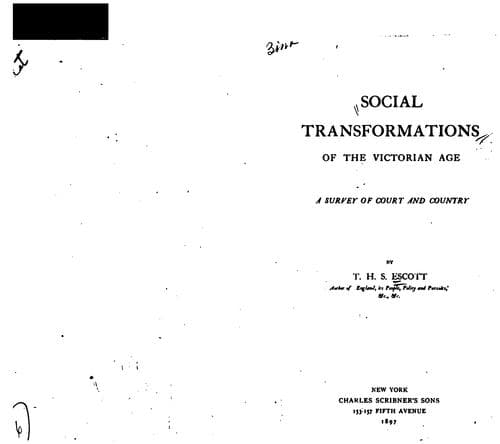
Social Transformations of the Victorian Age: A Survey of Court and CountryEscott, T. H. S. (Thomas Hay Sweet)
History
Social Transformations of the Victorian Age: A Survey of Court and Country
Escott, T. H. S. (Thomas Hay Sweet)
Great Britain -- Civilization -- 19th century; Great Britain -- Social life and customs -- 19th century
'Made in Germany' is a phrase round which there has centred lately much
controversy, political, economical, social and personal. This will have
prepared the reader to hear that on an analysis of the nationality of our
foreign residents, Germany heads the list with 50,599; Poles and Russians
come next with 45,074; then the French with 20,797; afterwards follow in
the order indicated with numbers fluctuating between 10,000 and 5,000
Austrians or Hungarians, Dutch, Norwegians, Swiss; no other nationality
contributed more than 5,000; the Russian and Polish names, which, after
the Germans, constitute the majority are so unmistakable as to render a
comparison between their numbers in 1881 and in 1891 tolerably safe. This,
for reasons already stated, is not so in the case of foreigners with less
distinctive patronymics. In 1881 the Poles or Russians enumerated were
14,468; in 1891 they were 54,074; the increase in ten years had thus been
some 212 per cent. Germans, in number 50,599, constitute nearly one-third
of our whole foreign population. Of that moiety, 1,981 are teachers; 1,198
musicians; 5,358 domestic servants in private families or inns; 659 are
professional cooks. To pass to a higher social category, 1,207 Germans are
established in business as brokers and merchants; 1,966 as clerks; 393 are
commercial travellers; 2,833 are sea-faring men; 282 are jewellers or
goldsmiths; 889 are watchmakers; 794 cabinetmakers; 1,309 are butchers;
2,340 are bakers; 276 are sugar refiners; only 592 are classed as general
labourers; 5,042 are occupied in ministering to the needs, luxuries, or
vanities of the person from the making of coats to the dressing of hair,
or the preparation of feathers for Court head dresses.
From these figures two facts of some interest emerge. The business clerks
who are complained of as interfering so disastrously with the clerical
labour market of Englishmen do not represent the largest contingent of
Teutonic industry among us. Numerically the most serious competition of
German with English industry is in the case of domestic servants. German
tailors are second in order of importance; the clerks come after, not only
these, but other occupations. Next to Germany, Scandinavia, Belgium and
Spain seem to supply the most numerous competitors with the industry of
the British middle classes.
Public-domain text, read in full here on John Shaqi.
Reviews
Reviews
No reviews yet
Be the first to share your thoughts on this work.
Elsewhere in the archive
Join the Discussion
Join the discussion
Sign in to leave a comment or review.
Sign InorCreate an account