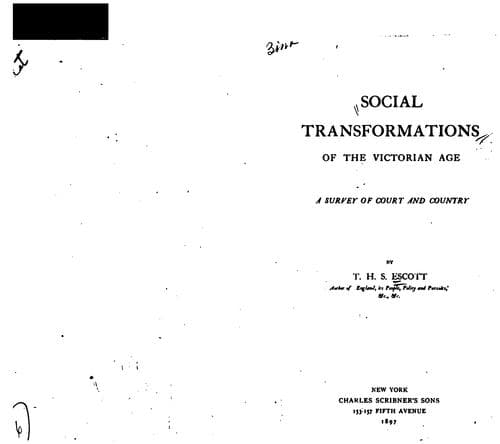
Social Transformations of the Victorian Age: A Survey of Court and CountryEscott, T. H. S. (Thomas Hay Sweet)
History
Social Transformations of the Victorian Age: A Survey of Court and Country
Escott, T. H. S. (Thomas Hay Sweet)
Great Britain -- Civilization -- 19th century; Great Britain -- Social life and customs -- 19th century
The growth of the purely English population, not complicated by any
foreign elements accompanied, as it has been, with a steady increase of
national prosperity is enough to supply instructive material to the
philosophical enquirer into the facts and figures of English progress
during the Victorian epoch. Before looking into these by the light of the
once accepted theory of population it will be as well clearly to state
what these doctrines are, as well as to summarize the criticisms to which,
on the face of them, they are open. The doctrine of Malthus was first put
forward by him at the end of the last century. During the first years of
the present, while the reverend philosopher was professor of history and
political economy at Haileybury, few subjects excited so much interest or
controversy among writers on political philosophy or comparative
statistics. The doctrine, as it was originally propounded by its author,
is that population tends to increase in geometrical ratio, that
subsistence only increases in numerical ratio. It followed, therefore,
that unless the population be periodically thinned by the external
influences of pestilence or war, the poorest classes chronically must be
at starvation point, and that unless the multiplication of the race be
checked by prudential restraints, within a given time the point will be
reached at which the population on this planet is altogether in excess of
the means for its support. On the threshold of the discussion which this
proposition elicited, the obvious remark was that it asserted not an
actuality but a possibility. Hence, unless, instead of a tendency, a
proved experience could be asserted; unless, in other words, in the place
of a tendency to increase existing, a historical increase could be
established, the commentators on Malthus maintained that the danger which
he foresaw was too remote to be reckoned with. The following is the line
taken by the critics of the Malthusian theory. It was declared to rest
upon a series of hypotheses which as a matter of fact were never
fulfilled. Granted that if the progression foreseen by Malthus took place,
the calamity apprehended must ensue; it was maintained, as a matter of
fact, that the abundant safeguards existing in practice were ignored by
the alarmist _doctrinaires_. Supposing each marriageable pair upon the
earth to marry first, and to produce afterwards as many children as a
normally healthy couple may expect, not only subsistence, but standing
room in this world would fail them. Experience, however, shows the
fulfilment of any such forecast to be a moral impossibility. In daily
practice there are apart from difficulty of subsistence many checks which
avail to keep increase of population within reasonable bounds.
Public-domain text, read in full here on John Shaqi.
Reviews
Reviews
No reviews yet
Be the first to share your thoughts on this work.
Elsewhere in the archive
Join the Discussion
Join the discussion
Sign in to leave a comment or review.
Sign InorCreate an account