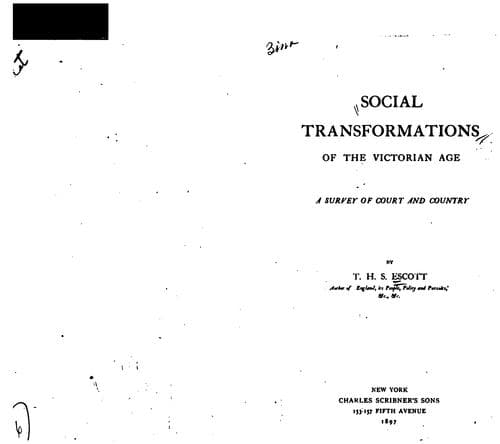
Social Transformations of the Victorian Age: A Survey of Court and CountryEscott, T. H. S. (Thomas Hay Sweet)
History
Social Transformations of the Victorian Age: A Survey of Court and Country
Escott, T. H. S. (Thomas Hay Sweet)
Great Britain -- Civilization -- 19th century; Great Britain -- Social life and customs -- 19th century
Constitutional Government and a popular legislature, did on Her Majesty's
accession, both exist in England. Neither of them was more than four or
five years old. Each therefore had arrived only at the experimental stage.
The Reform Bill of '32 had scarcely begun to be operative when its
imperfections made themselves felt. For the first time indeed in English
history popular constituencies had been organized by that Measure. But
while all householders rated at £10 and upwards had a voice in the
national Government, various old historic franchises had been abolished.
At Preston, for example, the suffrage had previously been in practice
universal; so that there, and at Windsor like Preston, the Reform Act had
a disfranchising effect.[51] All sections of the middle class were
enfranchised by the Measure of 1832.
With some show of reason it was complained that, while numbers were now
supreme, opinions and interests were, as in the case of pocket boroughs,
better able to make themselves felt under the nominally exclusive régime
which had been swept away. The new constitution was not the only
parliamentary novelty that signalized the opening of the Victorian epoch.
In addition to a new parliament returned by fresh constituencies there had
recently risen at Westminster a new Palace containing of course a House of
Commons comparatively fresh from the workmen's hands. The old structure
had been burnt down in 1834. The pile of buildings designed by Barry as
its architect which is now so familiar a feature in the London landscape
did not assume its present proportions in all their completeness till the
reign had entered upon its second decade. During the six years between
1834-40 the Houses sat in a temporary building which had been run up with
miraculous rapidity. As nearly as possible ten years after Her Majesty
received the early visit of her Chancellor at Kensington Palace, more
exactly on April 13, 1847, the Peers took possession of their new
Chamber.
Three years later, May 30, 1850, the Commons met for the first time
beneath the roof that shelters them to-day. Since the People's
Representatives and the Barons were constituted into separate Assemblies,
the building which the famous Clock Tower surmounts is in fact the fourth
meeting place that has been assigned to the Commons of England. It was not
till 1547, the first year of Edward VI. that the chapel of St Stephen in
Westminster Palace was prepared for the Commons. Before that date they had
assembled in the Chapter House.
Public-domain text, read in full here on John Shaqi.
Reviews
Reviews
No reviews yet
Be the first to share your thoughts on this work.
Elsewhere in the archive
Join the Discussion
Join the discussion
Sign in to leave a comment or review.
Sign InorCreate an account