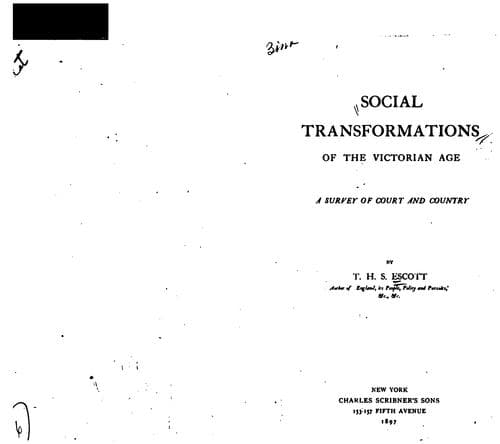
Social Transformations of the Victorian Age: A Survey of Court and CountryEscott, T. H. S. (Thomas Hay Sweet)
History
Social Transformations of the Victorian Age: A Survey of Court and Country
Escott, T. H. S. (Thomas Hay Sweet)
Great Britain -- Civilization -- 19th century; Great Britain -- Social life and customs -- 19th century
The explanation can only be that several new, as they are often nameless
industries have during this time come into existence. Birmingham, the home
of small industrial enterprises and in a less degree Sheffield, would of
themselves explain the mystery. And here specific mention of a personal
experience seems necessary. When the present writer by local observation
was first acquiring material for such writing as that of which this book
consists, he visited among other places Sheffield, under the obliging
personal conduct of its then, and happily its present, Member, Mr A. J.
Mundella. Close to one of the largest factories in that capital of cutlery
and furnaces is a small establishment owned by a single proprietor who
from that source of income alone, has realized a considerable fortune.
This gentleman contracts for the purchase of all the refuse, the waste
paper, the gilt or tin foil and other unconsidered trifles included which
accumulate in the rubbish heaps of other premises. On their reaching his
place of business, they are placed in a furnace; all the impurities are
burnt out of them. There remains a nondescript residuum of charred and
apparently worthless substances. Some of these, however, contain particles
of gold dust; these are placed into a crucible; eventually there is often
left a deposit of the precious metal which the jewellers are ready to buy.
The gold watch chain worn by the Sheffield industrialist now spoken of,
was of several carats, and was manufactured entirely out of the yield of
this refuse. The incident is worth mentioning as a concrete suggestion
drawn from real life of the protean methods of industrial money-making
that are constantly being discovered by the ingenious and unabashed
industry which in Virgil's phrase, conquers all things.[50]
CHAPTER XVIII
THE HOUSE OF COMMONS AS A LANDMARK OF POLITICAL PROGRESS UNDER QUEEN
VICTORIA
Comparative novelty of constitutional government as understood to-day,
and of real parliamentary representation during the first years of the
Queen's reign. Dissatisfaction with, and defects in, Lord Grey's
Reform Act. The new Chamber for the Commons nearly contemporary with
the reformed House. Retrospect of different places in which the
Commons have sat. Growth of social conveniences at Westminster. Recent
changes that after half a century would most strike the visitor to
Westminster. The ladies in Parliament. Discomforts of their earlier
parliamentary position as compared with its luxuries and ascendancy
to-day. Changes in the House itself. The day of the youthful M.P.
Modifications in the procedure of the House of Commons. Obstruction.
Its origin and prevention. Influence of the House to-day.
Public-domain text, read in full here on John Shaqi.
Reviews
Reviews
No reviews yet
Be the first to share your thoughts on this work.
Elsewhere in the archive
Join the Discussion
Join the discussion
Sign in to leave a comment or review.
Sign InorCreate an account