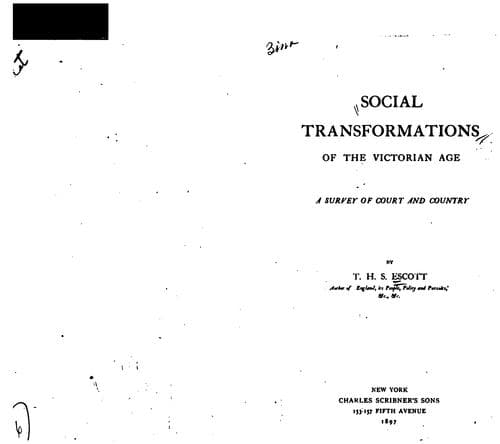
Social Transformations of the Victorian Age: A Survey of Court and CountryEscott, T. H. S. (Thomas Hay Sweet)
History
Social Transformations of the Victorian Age: A Survey of Court and Country
Escott, T. H. S. (Thomas Hay Sweet)
Great Britain -- Civilization -- 19th century; Great Britain -- Social life and customs -- 19th century
Amazement, approbatory or the reverse, at this spectacle is the beginning
of surprises which the spectral visitor would find in store. Descending
into the hall which separates the two Houses, he would meet a commoner
acting as a squire of dames, escorting detachments of ladies to points
whence they could best see the House of Commons celebrities of the hour.
Looking through the swing door of the Representative Chamber, the
parliamentary Rip Van Winkle would for the first time in his experience
note the flutter of muslins and silks through the grating that bars the
compartment just above the reporters' benches, and that is known to-day by
the name of the Ladies' Cage. In 1834 this was a novelty as yet undreamed
of. The germs of it may perhaps first be detected during the opening year
of the present century.
In 1800 the admission of the Irish Members after the Act of Union involved
structural alterations in the Chamber. Among other things a chandelier was
fixed in the centre of the ceiling. At the same time a round hole was cut
for the escape of the hot air. The top of the orifice was protected by a
balustrade. From above this chandelier ladies were permitted
surreptitiously to peep over. In that extremely uncomfortable and rather
perilous position they saw what they could of the speakers and heard
murmurs of the debate. The first subsequent novelty was the introduction
of a few chairs. The temporary structure for the Commons after the 1834
fire was in the old House of Lords formerly known as the Court of
Requests, occupying as it did much, if not all, of the site of Edward the
Confessor's palace. The Lords themselves at that time met in the present
St Stephen's where the Commons meet to-day. Nor was it till after the
first Reform Bill that the domiciles of the two Assemblies were exchanged.
Public-domain text, read in full here on John Shaqi.
Reviews
Reviews
No reviews yet
Be the first to share your thoughts on this work.
Elsewhere in the archive
Join the Discussion
Join the discussion
Sign in to leave a comment or review.
Sign InorCreate an account