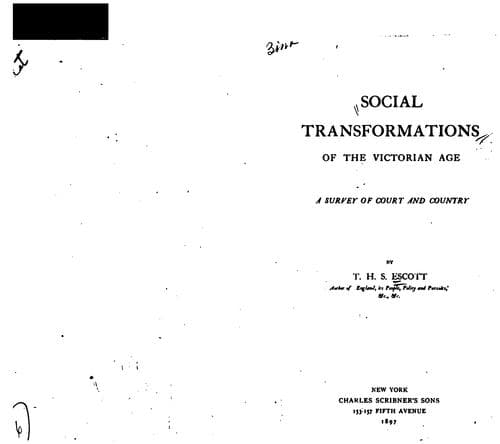
Social Transformations of the Victorian Age: A Survey of Court and CountryEscott, T. H. S. (Thomas Hay Sweet)
History
Social Transformations of the Victorian Age: A Survey of Court and Country
Escott, T. H. S. (Thomas Hay Sweet)
Great Britain -- Civilization -- 19th century; Great Britain -- Social life and customs -- 19th century
In the building which served the Commons between 1836-40, no provision was
made for ladies. By the report of the select committee of 1836 this fresh
accommodation was suggested. On the 3d of May in that, or in the following
year, the House ordered[52] that a place should be provided where, with
less discomfort, and more dignity than from the lamp balustrade, ladies
could listen to the speeches, and catch an occasional glimpse of those who
delivered them. In the temporary structure the exact spot thus allocated
to them seems to have been behind the Speaker's chair, if not actually
beneath the floor. Experts at least have discovered no alternative
situation as possible. The Ladies' Gallery of to-day as it exists just
above the Reporters' box is divided into three parts. The western third is
reserved for Mrs Speaker. It is called by that lady's name. Here she
receives as her guests personal friends or semi-official personages of her
own sex. The two eastern thirds of the compartment now spoken of are at
the disposal of Members for their wives and friends. There is a ballot for
the Ladies' Gallery a week in advance. Certain representatives of the
people have been favoured, as the result of consummate dexterity or rare
luck, with singularly uniform success in this ordeal. During the earlier
period to which reference has been made, there are believed to have been
instances in which ladies clandestinely found a place not only in the
balustrade above but in the ventilating chamber beneath the floor. Thus,
when they did not flutter as angels above, they burrowed like moles below.
Nor, as we have seen, was it till Barry's plan had become an architectural
fact that the wives and daughters of the people's elect were delivered
from these two predicaments.
To-day a lady visiting the House of Commons during debate has her 5
o'clock tea as comfortably as in her own drawing room. If the weather be
sultry, or the debate tedious, she can refresh herself during the interval
between tea and dinner with strawberries and ice as luxuriously as at
Gunter's in Berkeley Square. During the more monastic period of the modern
House of Commons, there occurred a short interval in which a very few
ladies on the floor of the House itself on the same side as the Treasury
Bench were stationed on chairs so placed that their occupants could hear
without being seen. One day a sudden witticism of an orator upset the
gravity of the listening stateswomen, and scandalized the Speaker. That
laugh proved fatal. Henceforth Members were forbidden expressly by the
House to secrete ladies in any part of the Chamber, either above or under
the floor. To-day in the interior of the Chamber itself ladies are not
more visible than formerly. The proposal to remove the grille that
converts their gallery into a cage is still made periodically; but with as
yet no great appearance of success.
Public-domain text, read in full here on John Shaqi.
Reviews
Reviews
No reviews yet
Be the first to share your thoughts on this work.
Elsewhere in the archive
Join the Discussion
Join the discussion
Sign in to leave a comment or review.
Sign InorCreate an account