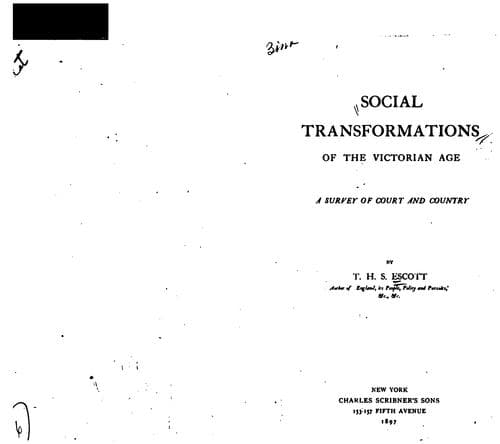
Social Transformations of the Victorian Age: A Survey of Court and CountryEscott, T. H. S. (Thomas Hay Sweet)
History
Social Transformations of the Victorian Age: A Survey of Court and Country
Escott, T. H. S. (Thomas Hay Sweet)
Great Britain -- Civilization -- 19th century; Great Britain -- Social life and customs -- 19th century
Outside but still beneath the parliamentary roof, or within the
parliamentary precinct, the sex that is no longer 'suppressed,' pervades
the place at all hours. The Members' dining room, where male strangers can
be invited, is not yet open to guests of our new _ecclesiazusæ_. All other
parts of the premises are already pervaded by them. In the basement a room
has been discovered in which the fair guests of Members can be
entertained when the debate is over by a supper which may well repair the
omission of a dinner. The river frontage of the Westminster Palace during
some years has been surrendered at discretion to the politicians of the
petticoat. Lord Redesdale foresaw the coming resemblance of the interior
of the Peers' Chamber to a music and dancing saloon. Even his alarmist
imagination never pictured at the height of the London season an assembly
of ladies upon the Terrace just outside the Chamber, enjoying as the
guests of the elected of the democracy ices, strawberries and cream, all
the other modish adjuncts of 5 o'clock tea. This they have done since
1888. More recently there have been added waitresses attractively dressed
in a black and white uniform. Some years ago Mr John Bright, a special
habitué of the tea room, arranged a subscription for a wedding present to
the young person who presided over the cups and saucers, when on her
marriage she retired into private life. Even that statesman would not
perhaps have undertaken his graceful and chivalrous task in the case of a
whole regiment of tea room nymphs.
The lady M.P. has still to come into existence. Her sex controls votes and
vicariously receives them. In New Zealand and other Colonies the same sex
records votes directly as well as influences votes indirectly. If, as
other precedents might suggest, the mother country is advancing towards
the Colonial usage, is there any abiding reason why to their parliamentary
influence already established beyond doubt, the mothers and daughters of
England should not add the responsibility to public opinion which a
parliamentary seat would bring and which they now escape?
Public-domain text, read in full here on John Shaqi.
Reviews
Reviews
No reviews yet
Be the first to share your thoughts on this work.
Elsewhere in the archive
Join the Discussion
Join the discussion
Sign in to leave a comment or review.
Sign InorCreate an account