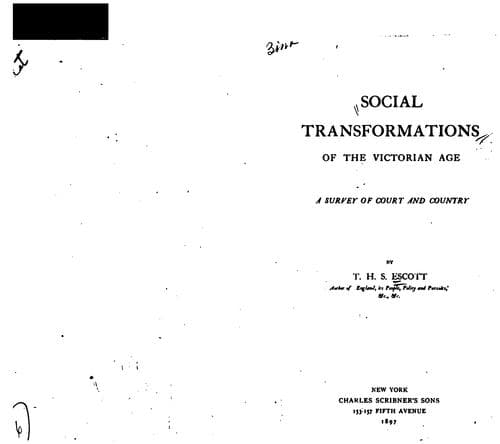
Social Transformations of the Victorian Age: A Survey of Court and CountryEscott, T. H. S. (Thomas Hay Sweet)
History
Social Transformations of the Victorian Age: A Survey of Court and Country
Escott, T. H. S. (Thomas Hay Sweet)
Great Britain -- Civilization -- 19th century; Great Britain -- Social life and customs -- 19th century
These were the men, contemporaries of Disraeli and Northcote, brought up
in the same parliamentary, often in the same social, school as them.
These, too, were they who for his mastery of parliamentary law, his
excellence of parliamentary manner, and his maintenance of historic
standards in parliamentary debate, could almost tolerate the Liberalism of
Mr Gladstone. With a pang they anticipated the day when his withdrawal
would rob the Assembly of the last surviving monument of the eloquence and
bearing which used to be the familiar attributes in the first assembly of
gentlemen in the world. Already debating of the old stately order had
begun to go out of fashion. Thirty years after the Queen's accession, in
the Reform discussions of 1867, Mr Lowe had made one of the latest and
happiest hits ever secured by a familiar phrase from Virgil. In 1881,
after the death of Lord Beaconsfield, Mr Gladstone pointed a reference of
the same kind with not less felicity when he applied to his rival on
returning from Berlin the words by which the Latin poet indicated the
commanding presence of Marcellus among the winners of the _spolia opima_.
With these exceptions, there is no recent record of signally successful
quotation in the House of Commons from classical authors. Not indeed for
want of classical scholars. Professor Jebb, Sir G. O. Trevelyan, Sir M. W.
Ridley, are at least the equals in this respect of their seniors.[53] The
simple reason is that Latin and Greek quotation which were once held to
be, as Mr Disraeli said of invective, an ornament of debate, have passed
into the heritage of outworn words and faces. To-day if honourable
gentlemen illustrate their meaning by a metaphor or clench an argument by
an epigram, they go for their _tropes_ and ideas, not to the library, but
to the laboratory. Thus one of them not long since was heard to compare
the mind of an opponent to a series of condensing chambers. The masters of
the grand style in parliamentary oratory, as it may be called, cannot be
said to have passed away while David Plunket, Lord Rathmore, lives. But
the business of the House of Commons is done in Committee. A Committee of
the House of Commons is like a committee of any other gentlemen
professedly met together to transact the greatest amount of work in the
shortest space of time. Telling arrangement of ideas, clearness of
thought, conciseness of phrase, dexterous support of special views by
figures and facts; these are the qualities bred in the parliamentary
atmosphere to-day. In such categories are the ideals consciously aimed at
to be found. No competent person seriously supposes the average of
intellectual power in Parliament to have declined. Mr Gladstone and other
experts have testified that it has increased, and that the 1893 Parliament
contained more men of first rate capacity than any within modern memory.
Public-domain text, read in full here on John Shaqi.
Reviews
Reviews
No reviews yet
Be the first to share your thoughts on this work.
Elsewhere in the archive
Join the Discussion
Join the discussion
Sign in to leave a comment or review.
Sign InorCreate an account