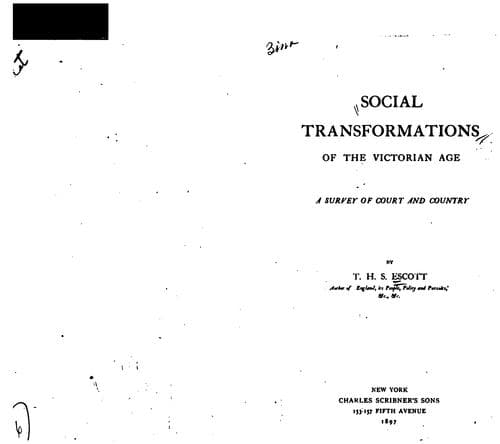
Social Transformations of the Victorian Age: A Survey of Court and CountryEscott, T. H. S. (Thomas Hay Sweet)
History
Social Transformations of the Victorian Age: A Survey of Court and Country
Escott, T. H. S. (Thomas Hay Sweet)
Great Britain -- Civilization -- 19th century; Great Britain -- Social life and customs -- 19th century
The interest taken by the nations in the doings of the House of Commons
has not permanently abated, nor is likely to do so, seeing that its
attraction resides less in the letter of its debates than in the
circumstance of its being a continuous commentary on the social as well as
political history of the day, a concentration, epitome, and amalgam of the
human nature of the period. The vicissitudes of human affairs, the sudden
growth, the not less sudden rupture, of human friendships; the involuntary
perjuries of political allies surely as laughable in the sight of Jove as
the perjuries of lovers; the sworn confidants and colleagues in one
Administration transformed into the mortal antagonists of the next; these
are the episodes of everyday life reflected upon the stage of the Theatre
Royal St Stephen's. Can they then, fail to be more full of dramatic charm
than the entertainments provided in any other playhouse of the realm? The
parallel between the theatrical and parliamentary stage might be made
still closer. As on the former, so on the latter there are certain stock
parts always sure to be enacted, whatever the title of the play, or the
nature of the discussion.
The Mr Henley already named, pre-eminently representative as he was of the
hard good sense and rugged honesty of the Tory squire, was not a novelty
in the Chamber. He had his forerunner in the 'down-right' Shippon, as Pope
calls him, of a Georgian House of Commons. He it was who, as a Jacobite
opposed to Sir Robert Walpole yet said of himself and his adversary, 'He
is for King George; I am for King James. We differ on most things; but
Robin and I are the two most honest men in Parliament.' The theatrical and
parliamentary analogy might be illustrated much further. One or two more
instances will suffice. The stage character whose chief function is to
keep the audience smiling and to enliven dulness by a laugh has his exact
analogue in the parliamentary humorist, whose very rising is the signal
for a burst of anticipatory merriment. In the nineteenth century the name
of that humorist has been, during its first half, Sir Charles Wetherell.
He relieved the severity of the 1831-2 Reform Bill discussions by
convulsing his hearers with laughter at the farcical absurdity of his
sallies, or by the ludicrous incongruity of the metaphors with which he
pointed his invective.
Half a century later the name of the performer is changed. The function
discharged is identical. In the place of a Wetherell there sits now a
Bernal Osborne, now a Patrick Boyle Smollett, now a William Gregory, and
again a Wilfried Lawson, or a Labouchere. In any case the wag is
indispensable to the proceedings of the House. In every new Parliament he
makes his appearance, if not quite so early, yet with the same regularity
as the Queen's Speech, or the Debate on the Address.
Public-domain text, read in full here on John Shaqi.
Reviews
Reviews
No reviews yet
Be the first to share your thoughts on this work.
Elsewhere in the archive
Join the Discussion
Join the discussion
Sign in to leave a comment or review.
Sign InorCreate an account