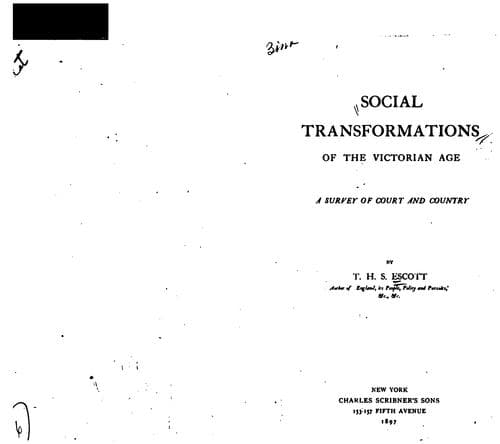
Social Transformations of the Victorian Age: A Survey of Court and CountryEscott, T. H. S. (Thomas Hay Sweet)
History
Social Transformations of the Victorian Age: A Survey of Court and Country
Escott, T. H. S. (Thomas Hay Sweet)
Great Britain -- Civilization -- 19th century; Great Britain -- Social life and customs -- 19th century
Other rôles are equally familiar, and with the same undeviating regularity
are forthcoming. High or Low Church, dry or Evangelical, the different
champions of the Church, each in their own era and from their own point of
view, come forward to defend the national Establishment. These are the
gentlemen whom in once addressing a deputation of them Mr Disraeli
characteristically styled 'the children of the Church.' Of this section,
during the earlier decades of the reign, Sir Robert Inglis was a chief.
Round him were grouped a little band in which Mr Spooner, and thereafter
the intrepid Mr Newdegate, and poor Mr Whalley, with his jaded, hunted
look, had a place. The burly presence of Sir John Mowbray, the less
robust, but wiry figure of Mr Talbot, both Members for Oxford University,
belong to a later date. When these may have disappeared, successors are
already visible to take their place. The stalwart form and patriarchal
beard of Sir John Kennaway, the less athletic and more sensitive figure of
Mr Stanley Leighton are even to-day powers in that ecclesiastical faction.
The two sons of Lord Salisbury, Lord Cranborne and Lord Hugh Cecil belong
to another generation, but to the same category of ecclesiastical
defenders.
During the Queen's earlier years, Chartism, that is to-day only a name,
was an active force. Most of the points of the Charter itself have quietly
become law. The Septennial Act has not indeed been repealed; but
practically the term of parliamentary life has been shortened. The ballot
has quietly superseded the hustings. Payment of Members is seriously
discussed. Election expenses have been much reduced. By the Redistribution
Bill of 1884, an appreciable step towards equal electoral districts has
been taken. The Georgian House of Commons, indeed the House till the full
effects of the first Reform Bill were felt, was so small, its members so
preponderantly came from the upper class of society as to give the
Assembly the air rather of a family party than of a national forum.
Public-domain text, read in full here on John Shaqi.
Reviews
Reviews
No reviews yet
Be the first to share your thoughts on this work.
Elsewhere in the archive
Join the Discussion
Join the discussion
Sign in to leave a comment or review.
Sign InorCreate an account