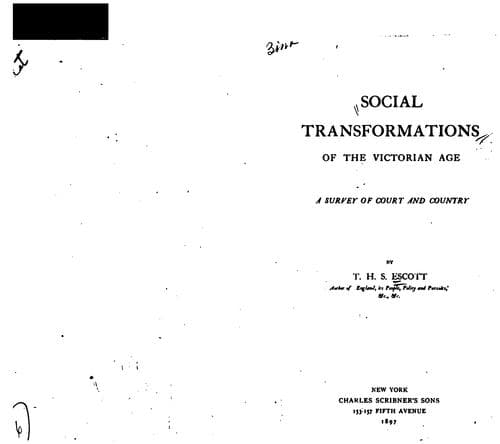
Social Transformations of the Victorian Age: A Survey of Court and CountryEscott, T. H. S. (Thomas Hay Sweet)
History
Social Transformations of the Victorian Age: A Survey of Court and Country
Escott, T. H. S. (Thomas Hay Sweet)
Great Britain -- Civilization -- 19th century; Great Britain -- Social life and customs -- 19th century
While the House of Commons as to arrangements, occupants and visitors has
changed more than once during the period comprised in this survey, there
has been in the opinion of experts like Mr Gladstone no diminution of
ability in its general debates. The amount of varied and accurate
knowledge displayed during discussions in Committee by the rank and file
of its members has increased appreciably since the Derby-Disraeli Reform
Act. But, it is said, as our constitution has become more democratic, our
popular legislators have grown unmannerly. Those who know the volumes of
parliamentary history summarizing debates in the House during the French
Revolutionary epoch of 1793-5 may be disposed to doubt the justice of this
censure. The violent personality of the recriminations between individual
members of the two Whig sections at this period; the revolting grossness
of the metaphors and the epithets by which the intellectual majesty of
Burke stooped to express his loathing for the new Radicals on both sides
of the Channel; the personal menaces exchanged by competitive debaters of
smaller calibre; leave no room for doubt on the point. Two years after the
first Reform Act, Church rates and other ecclesiastical topics gave rise
in the debates upon them to scenes and noises, cockcrowing amongst them,
that scandalised the parliamentary decorum of the period, as disgraceful
beyond all precedent. These incidents were attended by a degree of
parliamentary disorder which was habitually in excess of the ebullitions
however scandalous, provoked during the session of 1893 by the Second
Irish Government Bill of Mr Gladstone. The great change of recent years in
parliamentary methods is of course the organized obstruction on frivolous
and irrelevant pretexts raised during debate. Even this is not the novelty
that some have seemed to suppose. During that distant era when no
chandelier hung over the heads of Members, the only illuminants known in
the Chamber were candles. A formal motion was made that these should be
brought in. The early practitioners of obstruction seized upon this issue
to delay the discussion. Motions for adjournment became effective
instruments for delay during the Reform discussions of 1832. They were
then employed with success generally, and with humour sometimes by the
popular Sir Charles Wetherell, and in case of unpalatable amendments by Mr
Sheridan. While motions for adjournment have thus always been used as
methods of delay, they naturally have had different aspects at various
times. Thus when employed for fighting a Bill to which conscientious
objection was entertained, these motions differed entirely from those to
the same ostensible end made by the feigned opponents of perfectly
harmless Measures. Mr Pope Hennessy was practically the founder of this
later and indiscriminate opposition to all attempts to legislate.
Public-domain text, read in full here on John Shaqi.
Reviews
Reviews
No reviews yet
Be the first to share your thoughts on this work.
Elsewhere in the archive
Join the Discussion
Join the discussion
Sign in to leave a comment or review.
Sign InorCreate an account