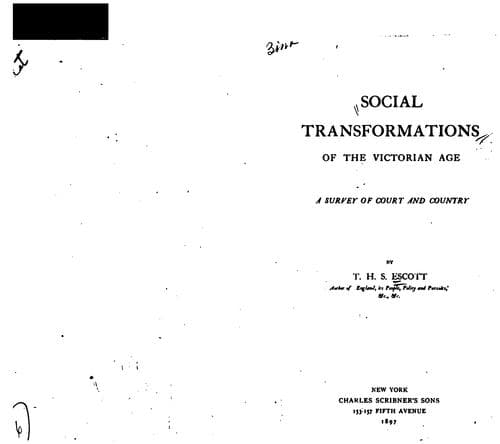
Social Transformations of the Victorian Age: A Survey of Court and CountryEscott, T. H. S. (Thomas Hay Sweet)
History
Social Transformations of the Victorian Age: A Survey of Court and Country
Escott, T. H. S. (Thomas Hay Sweet)
Great Britain -- Civilization -- 19th century; Great Britain -- Social life and customs -- 19th century
The late Mr Parnell extended that system to routine business such as the
nomination of Committees, also to unobjectionable votes in supply, and
finally in 1877 to private Members' Bills as well as Government Bills,
with the avowed aim of paralysing the whole machinery of Statute law. The
late Sir Stafford Northcote, who more than any other statesman of our time
resembled, in his conscientious caution and chivalrous devotion to
principle, Mr Perceval, dealt perhaps too gently with this abuse of forms,
nor saw fit to employ the new rule that was suggested to him by the
consummate experience of the late Sir Thomas May. Mr Gladstone's
management of this matter in 1881-2 was more drastic; it would have been
successful but for the tactics of the late Lord Randolph Churchill and the
present Sir John Gorst. After this came in 1888 the leadership of Mr W. H.
Smith, resulting as it did in 15 new Rules. The practical result of the
latest changes in House of Commons procedure may be summarized popularly
and briefly as follows. The French principle of closure already adopted in
all other Popular Assemblies is now part of the law of the English
Parliament. This instrument can be moved for at any time. It depends
wholly on the Speaker or, if the House be in Committee, on the Chairman,
whether the motion for it be put to the House. If put it is generally
opposed. Then follow debate and division. For its adoption there must be
not only a majority but one composed of not less than 100 Members.
With its larger numbers, the representative character of the House of
Commons has been increased also. The steps by which it has acquired
control of the executive as well as the legislative machinery of
government need not be recapitulated here. Its moral, educational and
social influence in the country is probably not proportionate to its
actual power. The theory of delegacy so indignantly repudiated by
Conservative speakers during the first Reform Bill debates is to-day
accepted and actively illustrated by a majority of Members. More and more
the tendency is for the constituencies to call into existence a
Government to undertake a specific task of legislation whose scope is
defined by the individual possessing for the moment the national
confidence. To support in that special work that particular statesman, or,
if he falls into disfavour, to thwart him, the householders send to St
Stephen's men whose discretion is restricted within very narrow limits.
Public-domain text, read in full here on John Shaqi.
Reviews
Reviews
No reviews yet
Be the first to share your thoughts on this work.
Elsewhere in the archive
Join the Discussion
Join the discussion
Sign in to leave a comment or review.
Sign InorCreate an account