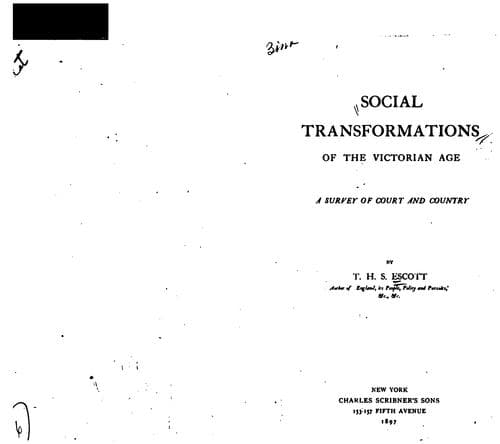
Social Transformations of the Victorian Age: A Survey of Court and CountryEscott, T. H. S. (Thomas Hay Sweet)
History
Social Transformations of the Victorian Age: A Survey of Court and Country
Escott, T. H. S. (Thomas Hay Sweet)
Great Britain -- Civilization -- 19th century; Great Britain -- Social life and customs -- 19th century
No thought of reverting to this family precedent has ever probably
occurred to her present Majesty. The comparison of the position
voluntarily occupied by the Sovereign to-day to that of the permanent head
of a great department of the State unchanged by Ministerial or electoral
vicissitudes, roughly but not altogether inaccurately conveys some idea of
the practical influence of the Crown upon the politics of the period.
Continuous experience of public affairs is not however the sole source of
the influence upon them which a constitutional monarch may be enabled or
obliged to exercise. The familiar Bedchamber Plot, presently to be
mentioned more in detail, and the momentary friction between the Sovereign
and her responsible statesmen that followed it, is now known to have
originated in a misapprehension. The Minister only desired that a few
ladies should give up their places in the Household. The Sovereign
resisted the dismissal of her entire suite. If, indeed, a solution of the
difficulty had not been found; if, that is, the Queen had pressed her
personal wishes to the point of the Premier's retirement, it is by no
means certain that she would have lacked constitutional arguments
justifying her course. A sort of plebiscite in 1841 had been given to Sir
Robert Peel. On some national issues of broader import, the popular
feeling at this time notoriously had not been expressed with convincing
clearness. On all sides there seemed balance and consequently confusion of
public opinion. From the altitude of her throne, and by the light of her
ancestral knowledge, the Queen might have argued that she saw the
situation more correctly than her Ministers in Parliament or her people
outside, and so have vindicated the dissolution of the House had she
chosen to adopt that course. This prerogative of sanctioning the recourse
of a Minister to the constituencies is one of which the Crown can never
finally divest itself. In the last resort, however much he may wish to
abdicate his power, the first magistrate of a State must be prepared on
that point for a definite individual responsibility. The latest
indubitable illustration of this truth was given in 1868. In that year Mr
Gladstone's Irish Church resolutions secured the defeat of the Disraeli
Government. The Conservative Premier did not, as precedent for doing even
then existed, resign immediately. He placed before the Queen the
alternative of a dissolution then, or six months later, leaving absolutely
to the Crown the responsibility of the choice. If that situation has not
since exactly repeated itself, obviously from the very nature of things it
is one which may at any moment recur. Thus it will be seen that under
parliamentary government, the self effacement of the Sovereign is an
impossibility. Years have passed since the sense of popular disappointment
at the visible results of the Grey Reform Act found expression in
_Coningsby_, and since the Sidonia of that romance ridiculed to his young
Public-domain text, read in full here on John Shaqi.
Reviews
Reviews
No reviews yet
Be the first to share your thoughts on this work.
Elsewhere in the archive
Join the Discussion
Join the discussion
Sign in to leave a comment or review.
Sign InorCreate an account