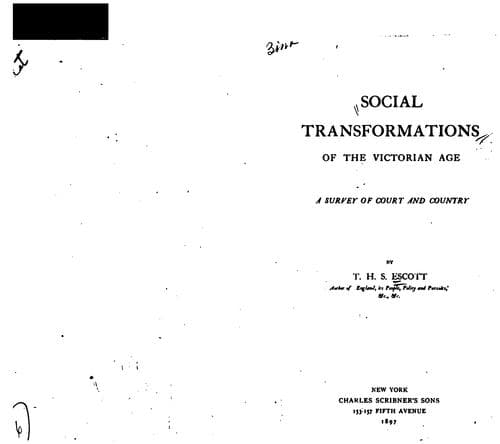
Social Transformations of the Victorian Age: A Survey of Court and CountryEscott, T. H. S. (Thomas Hay Sweet)
History
Social Transformations of the Victorian Age: A Survey of Court and Country
Escott, T. H. S. (Thomas Hay Sweet)
Great Britain -- Civilization -- 19th century; Great Britain -- Social life and customs -- 19th century
civic influence, been restored with interest to the Crown. The late Sir
Henry Maine, differing in that respect from earlier political theorists,
has in that very suppleness and elasticity which his predecessors praised
discovered a source of weakness to the English constitution. So shrewd an
observer as Mr Goldwin Smith bitterly complains of the fickleness of
popularly elected Parliaments, and their quickness to reflect the external
influences of the moment, as of the chief dangers to our political
stability. Into that controversy it is needless to enter. It may seem
strange to those who have had more than half a century's experience of her
loyalty to constitutional principles; but in 1837 no one certainly knew
whether the young Queen would not insist upon her technical right to
nominate and dismiss her Ministers at will. Less than four years had
passed since her uncle William IV. had practically exercised that
prerogative. In 1834 Lord Althorp was called by his father, Lord
Spencer's, death to the Upper House. Lord Grey had long wished to resign
the Premiership. His unsatisfactory relations with the King made him seize
this opportunity of doing so. The Sovereign accepted the resignation of
the Cabinet with more than alacrity. Substantially therefore, and
morally, there would seem something in the statement that William IV.
dismissed the Whigs to please himself.[56] As Mr Gladstone in one of his
essays has shown, the principle giving cohesion as well as joint and
separate vitality to the members of a Cabinet independently of the
personal pleasure of the Sovereign had been established before then. First
actively applied if not discovered by Sunderland, the son-in-law of the
great Duke of Marlborough, the Cabinet system, as Mr Gladstone has shown,
can scarcely be said definitively to have triumphed till 1828, when George
IV. reluctantly accepted Canning for Prime Minister. William IV., Mr
Gladstone's first Royal master, is, it may be noticed in passing, admitted
by his early servant to have used his prerogative unwisely; but is
defended from the charge of having used it unconstitutionally. So great is
the distance in political thought traversed since 1834 by the statesman as
well as by others.
Public-domain text, read in full here on John Shaqi.
Reviews
Reviews
No reviews yet
Be the first to share your thoughts on this work.
Elsewhere in the archive
Join the Discussion
Join the discussion
Sign in to leave a comment or review.
Sign InorCreate an account