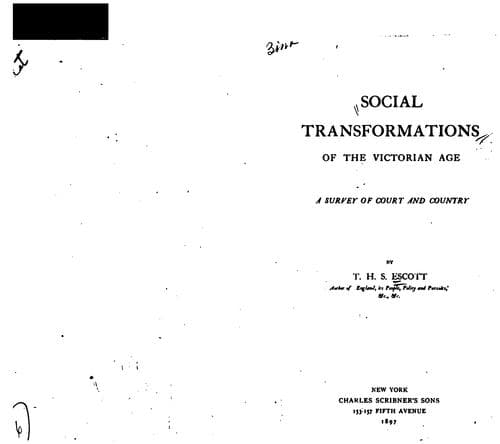
Social Transformations of the Victorian Age: A Survey of Court and CountryEscott, T. H. S. (Thomas Hay Sweet)
History
Social Transformations of the Victorian Age: A Survey of Court and Country
Escott, T. H. S. (Thomas Hay Sweet)
Great Britain -- Civilization -- 19th century; Great Britain -- Social life and customs -- 19th century
The younger Pitt is reported to have said that any man with £40,000 a year
had a right to a seat in the House of Lords. Some of his creations notably
that of Lord Carrington gave effect to that opinion. These peerages,
however, did but foreshadow faintly the elevations of men actually engaged
in commerce as in the case of Lord Armstrong, vicariously through his
widow in that of Mr W. H. Smith, and many more. The press, too, is not
less representative than the House of Commons. Nor in all probability is
Lord Glenesk the last representative of journalism, as he has been the
first to receive a seat in the Hereditary legislature. Under any
circumstances, the well placed English newspaper is likely to be not less
expository of public opinion than any body of gentlemen, by whatever mode
elected, sitting at Westminster. Special tendencies of the time make the
press an exceptionally lifelike measure of the thoughts and wishes in
every department of life of every section of the English people. Newspaper
proprietorship has in fact become not less a fashion of the day than
theatrical lesseeship was a few years since. A number of men agreed on
certain points such as the development or exploitation of particular
enterprises, are seized with the conviction that 'an organ' is essential
to their success. They combine, therefore, to buy or to press into their
service by subsidies some printed sheet which may yet have the ear of the
nation but which happens just now to have fallen upon evil times. If no
such opportunity as this present itself, newspaper starting has become a
recognized industry of commerce. After a time, therefore, a new literary
champion of the Empire enters the lists. Its real object may be narrow and
even personal. Its managers know that if their end is to be accomplished
it must be veiled by a programme of more disinterested generalities, and
that popular sentiment should form the first study of its conductors. In
this way therefore, apart from the great newspaper oracles of the time
which in all but name are national enterprises, the press has increasingly
an inducement, that never fails, to hold up the mirror to the convictions,
prejudices and sentiments into which public opinion can be analysed. The
reptile press of Germany is, upon any considerable scale, not known in
England. The connection between most journals whose support is envied, or
whose opposition is dreaded, and some or more of the leading public men of
the day, has been often very close[57] and is perhaps, still not quite
unknown.
Public-domain text, read in full here on John Shaqi.
Reviews
Reviews
No reviews yet
Be the first to share your thoughts on this work.
Elsewhere in the archive
Join the Discussion
Join the discussion
Sign in to leave a comment or review.
Sign InorCreate an account