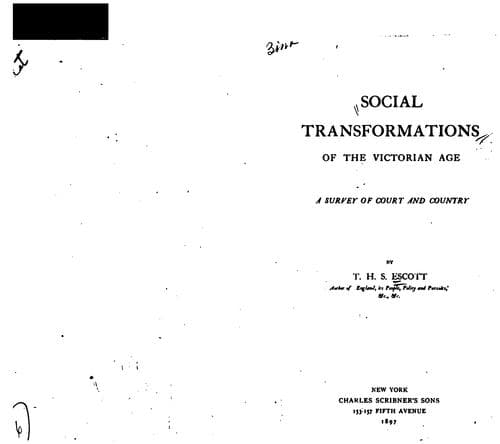
Social Transformations of the Victorian Age: A Survey of Court and CountryEscott, T. H. S. (Thomas Hay Sweet)
History
Social Transformations of the Victorian Age: A Survey of Court and Country
Escott, T. H. S. (Thomas Hay Sweet)
Great Britain -- Civilization -- 19th century; Great Britain -- Social life and customs -- 19th century
The newspaper, however, is but a single agency for the literary influence
exercised upon the public life of the day. Of late years periodicals,
appearing at less frequent intervals, have among politicians themselves
competed in attractiveness with the national assemblies at Westminster. In
proportion as parliamentary reports have been in the daily press reduced
to a few columns and in the case of all but speakers of the first rank to
a few paragraphs or sentences; parliamentarians themselves have
substituted the monthly Review for the stenographer or for Hansard as the
depository of their views. Technically the presence of reporters in the
gallery is even to-day connived at rather than constitutionally
sanctioned. Yet the leader of the House of Commons, not very long since,
reminded his hearers that those who were not present at his speech might
master his points by referring to the parliamentary reports next day.
Members with a taste for writing, having some carefully thought out
message to deliver on an intricate topic of foreign or domestic policy are
increasingly inclined entirely to pretermit the parliamentary stage of
their exposition. By reserving their remarks for the monthly periodical,
they can be sure of fixing popular attention more conspicuously. Their
signatures are appended to their effusions. The editor incurs no
responsibility either for the substance or the form of the opinions
delivered. The reciprocity of the arrangement is, between him and his
contributor, complete. On the one hand the literary impressario secures
the advertisement of a familiar if not a famous name, good as he knows it
to be for the sale of a certain number of copies, each one of which
represents a clear if a small profit. On the other hand, assuming the
senator to deserve an audience, he is more likely to secure one when his
views are placed before the public for the first time with all the
advantages of good type and paper, when they are read comfortably in
library or club, not listened to with an effort, and even then but
partially heard in the exhausted atmosphere of the House of Commons. Again
if the Popular Chamber still be of the same intellectual calibre as of
old, it has grown also more manifestly fastidious and more demonstratively
intolerant of speakers who do not hit its taste. As Sir James Mackintosh
and Lord Macaulay in different words both said, it was always a Chamber
whose tastes and verdict were incalculable. Since, under a democratic
franchise, it has become an Assembly primarily of business gentlemen, the
chances of failure to satisfy it are so alarmingly numerous as to prevent
all but the most self assured and impassive from making the effort. It
prides itself above all things on its business-like tastes. Therefore, it
abhors any approach to rhetoric. It fails not to remember its traditions
of eloquence, or the ascendancy over itself which to a master of words and
phrases, to a Disraeli, a Gladstone, a Lowe, a Canning, a Peel, it was
Public-domain text, read in full here on John Shaqi.
Reviews
Reviews
No reviews yet
Be the first to share your thoughts on this work.
Elsewhere in the archive
Join the Discussion
Join the discussion
Sign in to leave a comment or review.
Sign InorCreate an account