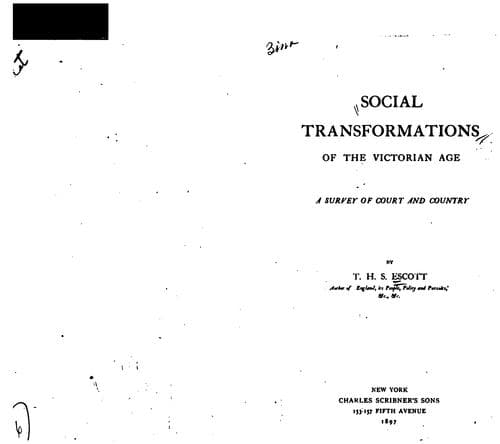
Social Transformations of the Victorian Age: A Survey of Court and CountryEscott, T. H. S. (Thomas Hay Sweet)
History
Social Transformations of the Victorian Age: A Survey of Court and Country
Escott, T. H. S. (Thomas Hay Sweet)
Great Britain -- Civilization -- 19th century; Great Britain -- Social life and customs -- 19th century
The Prince Consort's reforms in the economy and administration of the
Court itself, though not the least valuable or necessary of his labours,
naturally appealed less directly to the popular interest than his other
activities, by the results of which the land of his adoption is to-day the
gainer. Not a moment had been lost by the Prince in beginning to realize
his early idea of associating for the first time since the days of the
Stuarts the Sovereign with the promotion of letters, science, and art. The
Court of Henry VIII. had been visited by Erasmus, and by other men of
letters of the Protestant connection. If the story of Shakespeare's
presence in the group that surrounded Elizabeth be apocryphal, Edmund
Spenser, Sir Philip Sidney, and Sir Walter Raleigh undoubtedly paid their
homage to the Virgin Queen. Charles I. was the patron of Van Dyck and an
admirable connoisseur as well as encourager of true art wherever it could
be found. Charles II., after his restoration, was less interested in
painters and poets than in science.
Before Queen Victoria, the Hanoverian Sovereigns had not identified the
new dynasty with any special affection for the accomplishments which gild
and refine life. The Prince Consort, at the outset of his career mastered
two facts. First, he discerned, that, even in the absence of a national
scheme of education, the taste for reading and culture bred not only by
improved intelligence, but by the growth of material prosperity and the
humanizing influences of foreign travel, must before long result in a
marked improvement of the appreciation among the countrymen of Reynolds,
of Byron, of Wordsworth, and of Southey, of all that sweetens and
brightens daily existence. The Prince perceived, too, that the lines on
which English social intercourse was developing must involve a demand for
amusements and for recreations upon a larger scale than family reunions
beneath the domestic life could provide. The theatre in England had not
become then a considerable force. It would have been premature to
anticipate the later advice of Mr Matthew Arnold to organize the stage.
The demand for good music in public places and on reasonable terms; the
growing interest in the works of English artists; above all the newly
awakened interest among the whole community in the welfare of their least
fortunate members;--these are the features of the time which in his survey
of the domestic situation chiefly impressed the Prince.
Public-domain text, read in full here on John Shaqi.
Reviews
Reviews
No reviews yet
Be the first to share your thoughts on this work.
Elsewhere in the archive
Join the Discussion
Join the discussion
Sign in to leave a comment or review.
Sign InorCreate an account