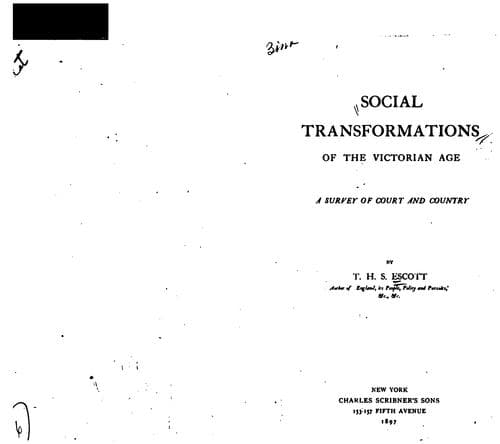
Social Transformations of the Victorian Age: A Survey of Court and CountryEscott, T. H. S. (Thomas Hay Sweet)
History
Social Transformations of the Victorian Age: A Survey of Court and Country
Escott, T. H. S. (Thomas Hay Sweet)
Great Britain -- Civilization -- 19th century; Great Britain -- Social life and customs -- 19th century
Other duties gradually gathered round
this personage. To-day, as the Prince Consort had always purposed, it is
upon him that there devolves the duty of issuing at the Royal command,
invitations to guests to sleep and dine beneath the Queen's roof.
The composition of the Queen's immediate entourage is now practically the
same as that decided upon by Her Majesty in conjunction with the Prince
Consort. The ladies of the Court, that is, consist of the Mistress of the
Robes, the Ladies of the Bedchamber, the Women of the Bedchamber, and the
Maids of Honour. The first named of these, the Mistress of the Robes, is
in her way, a State official. She must not be below the rank of a Duchess.
She changes with the Government of the day. Her attendance on the Queen is
limited to State occasions. The Ladies of the Bedchamber, all of them
peeresses, are in number eight. One of them is invariably waiting upon the
Queen. These are the ladies who in 1839 Sir Robert Peel, when forming his
Administration, thought should be changed. The Women of the Bedchamber are
also eight. These generally are only in attendance when the Mistress of
the Robes is present. One of them is always near the Sovereign. The Maids
of Honour are also eight in number. These must be either the daughters or
grand-daughters of peers. They have the courtesy title of 'Honourable.'
Two of them are always in waiting for a month at a time. The Prince
Consort also in selecting the officers of the Household, showed special
care and judgment in his choice of the person who discharges the duties of
Privy Purse. From the days of Colonel Phipps, or Colonel Anson, to Sir
Fleetwood Edwards; these have been men of first rate financial and
administrative capacity. Misled by a similarity of terms, some persons
seem to fancy there exists a vital association between the gentleman who
fills that position in the Queen's Household and the nobleman who, as Lord
Privy Seal, has a seat in the Cabinet of the day, and who in 1896-7 was
Viscount Cross. Hence the recurrent announcements in the newspapers that
this statesman has been summoned to Windsor or Balmoral to assist Her
Majesty with her business papers. The present opportunity therefore may
usefully be taken to contradict the construction placed upon the character
of the visit of that Minister to the Court. This the present writer has
the very highest authority for doing. The connection between the Cabinet
and Court offices whose names so closely resemble each other is in no
sense organic. Lord Cross, now spoken of, is eminent for his knowledge of
business of all kinds. He is a man of the widest and most varied
experience in every department of civil and political affairs. He had a
seat in Lord Beaconsfield's last Cabinet. Than him the Queen possesses
to-day few older servants, or more trusty friends. In that capacity, not
in virtue of his Ministerial position, it is that Lord Cross finds
himself so frequently the guest of his Sovereign.
Public-domain text, read in full here on John Shaqi.
Reviews
Reviews
No reviews yet
Be the first to share your thoughts on this work.
Elsewhere in the archive
Join the Discussion
Join the discussion
Sign in to leave a comment or review.
Sign InorCreate an account