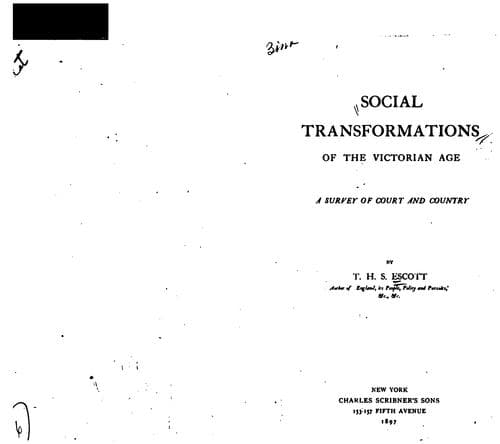
Social Transformations of the Victorian Age: A Survey of Court and CountryEscott, T. H. S. (Thomas Hay Sweet)
History
Social Transformations of the Victorian Age: A Survey of Court and Country
Escott, T. H. S. (Thomas Hay Sweet)
Great Britain -- Civilization -- 19th century; Great Britain -- Social life and customs -- 19th century
Nearly simultaneous with this was his appearance upon a public platform on
one of those non-political occasions that his example has specially
appropriated to the representatives of English Royalty. In the same year,
too, at the very height of the London season, the Prince took the
initiative in a function of a graver kind, but not less specially adapted
for energies and knowledge to which under a Constitutional monarchy
political life is not held to afford a proper outlet. The most important
public meeting of the summer of 1840 was that convened for the purpose of
encouraging the legislature to complete the machinery for the removal of
the last traces of the slave trade. Technically the abolition had already
taken place. Well grounded apprehensions, however, existed that the new
'apprenticeship' which was to educate the emancipated negro for the
blessings of freedom might sometimes be too much like the old servitude
which it was designed to supersede. This occasion produced the first
speech delivered on an English platform by the Prince Consort at a time
when platform eloquence was less common than it has since become. The
address pointed, pithy, without an ambiguous or superfluous word, was the
model by which the speaker may well have shaped his subsequent utterances.
Its terse felicities of phrase have since often been reproduced by his
son, the Prince of Wales. As a corrective to the innate nervousness of a
highly organized temper, he had carefully prepared these remarks, writing
them out and rewriting them, so that nothing might be left to the chance
inspiration of the moment.
Public-domain text, read in full here on John Shaqi.
Reviews
Reviews
No reviews yet
Be the first to share your thoughts on this work.
Elsewhere in the archive
Join the Discussion
Join the discussion
Sign in to leave a comment or review.
Sign InorCreate an account