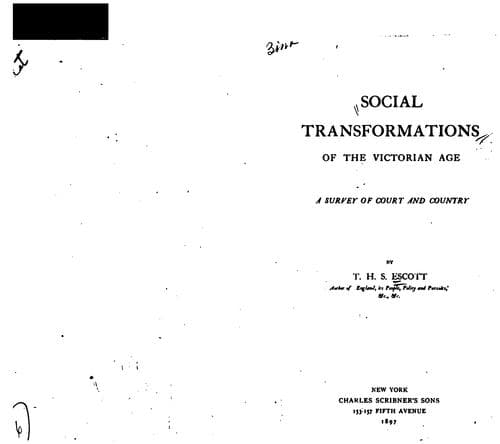
Social Transformations of the Victorian Age: A Survey of Court and CountryEscott, T. H. S. (Thomas Hay Sweet)
History
Social Transformations of the Victorian Age: A Survey of Court and Country
Escott, T. H. S. (Thomas Hay Sweet)
Great Britain -- Civilization -- 19th century; Great Britain -- Social life and customs -- 19th century
This was the first of a series of princely appearances on non-political
occasions. To-day, and in the case of his descendants, these things are
taken as a matter of course. During many years no great movement for the
improvement by politically unsectarian agencies of human life has been
considered complete without the active participation in it of the Crown,
or, which comes to the same thing, a nominee of the Crown. That in its
popular aspects the artistic movement which fills so large a space in the
second half of this century was practically the creation of the Prince
Consort's discriminating taste and patriotic industry would, if by
nothing else be shown by the course of preparations for the Hyde Park
Exhibition of 1851. Sir Robert Peel, at the time, repeatedly stated that
without the collaboration and counsel of the Queen's husband, the
Commission for the promotion and encouragement of the fine arts in the
United Kingdom could scarcely have got through its work. On the other
hand, while the public has accustomed itself to regard Lord Melbourne as
the nearly exclusive influence for training the Sovereign and her husband
in the tasks of Royal routine, one may point out that the Prince himself
never failed to emphasize his personal obligations to Sir Robert Peel as
his first trainer in the duties of an English public man. Nor from these
associations did he acquire only a correct insight into the official ways
of his new country. In his tastes and appreciations, the Prince Consort
became as patriotic as any of the great men by whom he was surrounded.
Some have questioned whether the patronage of a not unmixed English Court
has been entirely favourable to the development of native genius in
certain branches of the fine arts. The historic facts enumerated by Sir
Theodore Martin on this point are worth mentioning.[63]
Public-domain text, read in full here on John Shaqi.
Reviews
Reviews
No reviews yet
Be the first to share your thoughts on this work.
Elsewhere in the archive
Join the Discussion
Join the discussion
Sign in to leave a comment or review.
Sign InorCreate an account