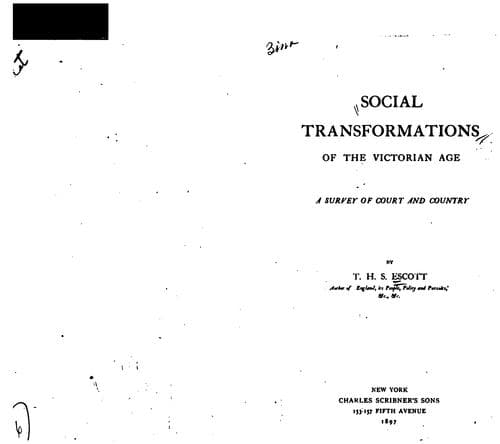
Social Transformations of the Victorian Age: A Survey of Court and CountryEscott, T. H. S. (Thomas Hay Sweet)
History
Social Transformations of the Victorian Age: A Survey of Court and Country
Escott, T. H. S. (Thomas Hay Sweet)
Great Britain -- Civilization -- 19th century; Great Britain -- Social life and customs -- 19th century
This (1842) was the year, too, in which the first steps, both in the
direction of officially identifying the representatives of the English
Crown with the encouragement of popular culture, and of continuing the
work begun by Sir Walter Scott, of popularizing Scotch scenery with
English visitors, was taken by the Prince Consort. The opening of the Art
Exhibition in Edinburgh; the addresses made by the Prince, with the minute
and exact study of artistic and scientific subjects which they showed, not
only satisfied experts, but delighted the general public, and practically
placed the Queen's husband in the van of the new movement for the
encouragement of popular knowledge, then beginning to advance more rapidly
than it had previously done. The whole country was agitated with the
premonitory risings of Chartism. The Prince's opportunities of good were
increased by the proof he afforded of combining manly courage with a
technical knowledge then new to the English people. For us to-day the
importance of these incidents is not merely biographical. They illustrate,
as nothing else could, the growth and the development of the popular
conception of the duties outside the Court that Englishmen connect to-day
with the Sovereign or the Sovereign's social and ceremonial vicegerents.
Since then the rapidity of the movements of the Heir Apparent as the
deputy of the Queen excite admiration mingled with some perplexity
concerning the means by which so near an approach has been made to solving
the secret of perpetual motion. In all this, for the first time by anyone
living within the Royal circle, the initiative was set by the Prince
Consort. Now the Prince was visiting with the Queen an English statesman,
for example Sir Robert Peel, at his country seat. A few days before, the
Royal visitors had been the guests of Louis Philippe in France. On landing
at Portsmouth, they at once started for Tamworth. Their visit at the
statesman's country house was scarcely concluded when the Prince Consort
was due at Cambridge for his installation in the Chancellorship of the
University. As the years went on these activities were multiplied. All the
great centres of English trade and manufacture, one day Birmingham, the
next Liverpool or Glasgow, Leicester or Leeds, were in turn, and upon the
same scale of ceaseless celerity, visited. When therefore, the Queen's
eldest son first entered upon public life and began to dazzle his
countrymen by the speed of his movements, or to gratify them by the
ubiquity of his presence, and indifference to fatigue of body or mind, it
is well to see these manifestations of princely energy in their historical
perspective, and to realize that in this transformation of Royal force,
which the present reign has witnessed, the Heir Apparent has not so much
created a precedent as fulfilled a tradition.
Public-domain text, read in full here on John Shaqi.
Reviews
Reviews
No reviews yet
Be the first to share your thoughts on this work.
Elsewhere in the archive
Join the Discussion
Join the discussion
Sign in to leave a comment or review.
Sign InorCreate an account