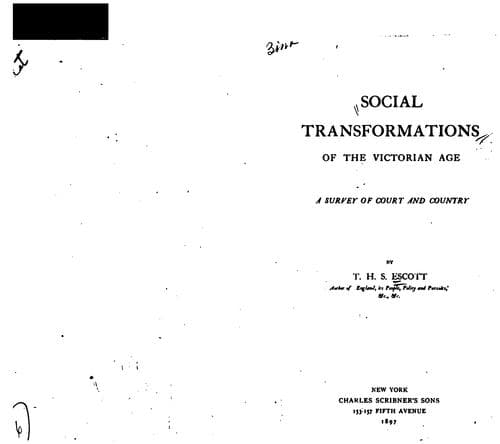
Social Transformations of the Victorian Age: A Survey of Court and CountryEscott, T. H. S. (Thomas Hay Sweet)
History
Social Transformations of the Victorian Age: A Survey of Court and Country
Escott, T. H. S. (Thomas Hay Sweet)
Great Britain -- Civilization -- 19th century; Great Britain -- Social life and customs -- 19th century
On December 2, 1841, the Prince met on the official business of the
Commission the Secretary, then Mr, afterwards Sir Charles, Eastlake. The
latter entered upon the interview with an idea of resigning his post,
should the Prince insist on the introduction of foreign artists. His Royal
Highness anticipated his visitor by volunteering the remark that to him
there appeared no necessity for so much as the employment of a single
foreign artist even among those entrusted with the management of
considerable works. 'In all that related to practical dexterity (the
department in which it was assumed that some instruction for fresco would
be necessary), the English were particularly skilful.' Such were the
Prince's words as recorded by Sir Charles Eastlake. The same narrator adds
that His Royal Highness volunteered many instances of English superiority
over all other nations in everything concerned with artistic mechanism.
'Even to the varnish on coaches,' said the Prince, 'it is surprising how
much more perfect the English practice is than that of the Continent.' The
talk then turned on the encouragement of fresco painting in England. The
words of the Queen's husband are especially noticeable showing as they do
his just appreciation of the conditions of artistic prosperity in England.
Two great auxiliaries in this country seldom fail to promote the success
of any scheme. Of the forces thus alluded to, fashion was one, high
example was another. Hence the Prince inferred that if the Queen and
himself set the example of having works of this kind done, the taste would
extend itself to wealthy individuals. The English country seats which are
the most beautiful in the world would acquire additional effect from the
introduction of such a style of decoration. With such occupation the
school would never languish, and would at least have time fully to develop
itself. When on one occasion Mr Eastlake, in reference to the necessary
limitation of frescoes compared them to sculpture in which nothing could
be concealed, and in which this necessity involved the necessity of beauty
also, the Prince replied: 'You have expressed in a few words what I would
have said in many.'[64]
Public-domain text, read in full here on John Shaqi.
Reviews
Reviews
No reviews yet
Be the first to share your thoughts on this work.
Elsewhere in the archive
Join the Discussion
Join the discussion
Sign in to leave a comment or review.
Sign InorCreate an account