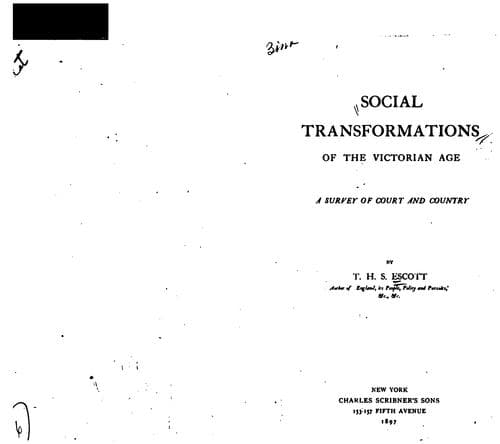
Social Transformations of the Victorian Age: A Survey of Court and CountryEscott, T. H. S. (Thomas Hay Sweet)
History
Social Transformations of the Victorian Age: A Survey of Court and Country
Escott, T. H. S. (Thomas Hay Sweet)
Great Britain -- Civilization -- 19th century; Great Britain -- Social life and customs -- 19th century
The same statesman is known at a little later date to have been persuaded,
not without difficulty, to abstain from sending a friend to his chief
opponent[65] at the time of the latter's onslaughts on the Conservative
concession of Free Trade. Since then, Wimbledon Common or Wormwood Scrubbs
has probably never for a moment seriously suggested itself to any
honourable gentleman as a possible place to which to adjourn a
controversy with a parliamentary opponent.
A duel was the incident which caused the first intervention of the Prince
Consort in the social arrangements of English life. On the 1st of July
1843, Colonel Fawcett had been shot by his brother-in-law, Lieutenant
Monro. The latter had accepted the challenge most reluctantly; he had been
the grossly aggrieved party.[66] Under the then existing code, the
survivor's sole alternative to the certainty of being stigmatised as a
coward had been to accept the risk of being hung for a felon. Eight years
before the Queen's accession, in 1829, however, the great Duke of
Wellington had faced Lord Winchilsea's pistol; the memories of the (1809)
Canning-Castlereagh and other encounters did not then seem part of ancient
history. The Prince Consort, with the military instincts of his race
decided that the reform which he was bent on establishing must begin with
the army. The authority of the Duke of Wellington was at this moment
paramount equally in social, political, and military life. The great
general was known himself seriously to have considered the subject. With
him therefore, the Prince arranged an interview. Courts of Honour were
suggested by the Prince as rational substitutes for the appeal to the
sword. The Tribunals des Marechaux were said to have done good work in
France; Courts of Honour had been followed with the best results in the
Bavarian army. The Duke's objection to the proposal was the English
distrust of a secret tribunal; the authorities of the navy took the same
view as the Commander-in-Chief. Sir George Murray, then Master of the
Ordnance, a serious and accomplished man of the world, bluntly remarked
that quarrels would not be made up, or differences composed by the
arbitration of others; that the law as it already existed could do all
which was practicable to repress the practice. The Prince persevered with
his purpose. His suggestion was laid by the Secretary of State for War
before his colleagues in the Cabinet. Though the scheme was not adopted in
the form suggested by the Prince, his action in the matter led to an
amendment in the Articles of War (April 1844). Henceforward it was
declared to be suitable to the character of honourable men to apologize
and offer redress for wrong or insult committed, and equally suitable for
the aggrieved party frankly and cordially to accept the amende. Thus on
the initiative of the Queen's husband, there began the organization of
public opinion on the lines that have long since made the ordeal by arms
Public-domain text, read in full here on John Shaqi.
Reviews
Reviews
No reviews yet
Be the first to share your thoughts on this work.
Elsewhere in the archive
Join the Discussion
Join the discussion
Sign in to leave a comment or review.
Sign InorCreate an account