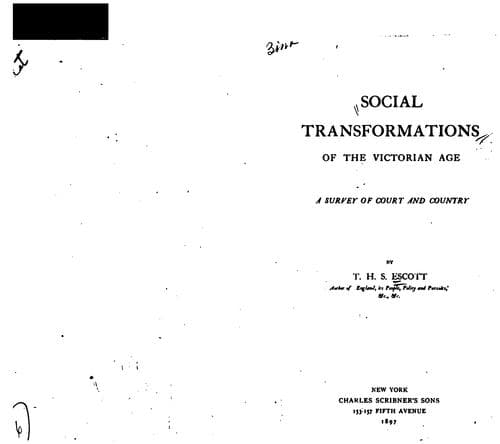
Social Transformations of the Victorian Age: A Survey of Court and CountryEscott, T. H. S. (Thomas Hay Sweet)
History
Social Transformations of the Victorian Age: A Survey of Court and Country
Escott, T. H. S. (Thomas Hay Sweet)
Great Britain -- Civilization -- 19th century; Great Britain -- Social life and customs -- 19th century
as practically obsolete in England as the ordeal by touch.
The Queen's devotion to her army has always been that of a mother for her
children; the Queen's gratitude evinced upon all possible occasions to her
soldiers for what they have done in the field has ever resembled that of a
woman to the protector of the weak against the strong. It was natural
therefore that, amid his civilian duties, the new representative of the
Throne, himself nurtured in a land that from being the Mark of Brandenburg
was growing into a great military monarchy, should actively show his
interest in the whole field of military reform. Later, when the post
became vacant, the Prince Consort, after consulting with the Ministers of
the day, declined more than once the Commandership-in-Chief. His
suggestions for army reform, and for national defence during the period of
the Crimean War, of the Indian Mutiny, and again during the
Franco-Austrian wars were made with a sense of responsibility which the
tenure of office could not have deepened as well as with a shrewd
perception of the needs and possibilities of the time that no statesman of
English birth could surpass. He had already been among the first to
recognize the brilliant merits of the Duke of Wellington's plan for the
defence of London, during the Chartist disturbances of 1848. To the
Prince's discrimination it is largely due that this domestic exploit of
the hero of Waterloo, not less memorable in its way than Waterloo
itself,[67] came properly to be appreciated by the country. To this day
the mighty fortresses which protect the shores of the Solent and
Southampton Water, and which make that part of the previously too
vulnerable South coast practically safe are to a great extent the
memorials of the wisdom and exertion of the Prince Consort. He had
already, while our soldiers were before Sebastopol, urged upon the
Government of the day the establishment of militia depôts in place of the
regulars should they be withdrawn by an emergency, at Malta and
elsewhere, along the line of our Mediterranean possessions. When
therefore, the national alarm caused by the words and actions of our
French ally found its expression in Lord Palmerston's scheme of coast
defences, the memorandum on which these measures were based had been drawn
up by the Prince Consort at the wish of the Cabinet, and practically
formed the basis of the action of Ministers.
Public-domain text, read in full here on John Shaqi.
Reviews
Reviews
No reviews yet
Be the first to share your thoughts on this work.
Elsewhere in the archive
Join the Discussion
Join the discussion
Sign in to leave a comment or review.
Sign InorCreate an account