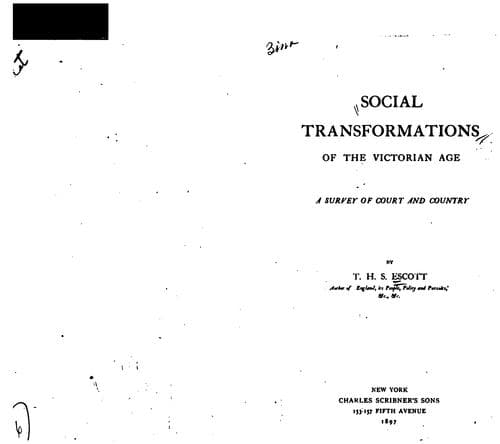
Social Transformations of the Victorian Age: A Survey of Court and CountryEscott, T. H. S. (Thomas Hay Sweet)
History
Social Transformations of the Victorian Age: A Survey of Court and Country
Escott, T. H. S. (Thomas Hay Sweet)
Great Britain -- Civilization -- 19th century; Great Britain -- Social life and customs -- 19th century
Almost till the beginning of the present decade there might be seen any
afternoon issuing from the Athenæum Club in Pall Mall, a well-set-up
gentleman, scarcely middle-aged, soldierly indeed of figure, but chiefly
noticeable for his commandingly intellectual brow. This was Edward Hamley.
Should the time now spoken of happen to have been that of the opening of
the Franco-Prussian War, Hamley was perhaps demonstrating to a civilian
friend the justification of his prediction of a French triumph afforded by
the slight advantage gained by French troops at the early affair of
Saarbruck; then came the French reverses. Hamley was not cast down. These
were tactical moves, only the preludes of decisive triumph; so things went
on till the day of Sedan arrived, when even General Hamley was constrained
to acknowledge a French failure. If, however, like most of his cloth, this
able and upright soldier was sometimes opinionated, he had earned almost a
right to be so by having done more than any other man of his generation
for the intellectual formation of the new order of English officer who
stands in such marked contrast to his predecessor. That young Aldershot,
Woolwich, or Sandhurst does not find time hang heavily on his hands when
there is no cricket match on, no race-meeting whither to drive his
dogcart, no afternoon train to town to catch, is chiefly due to the
intellectual habits which Hamley did more by example and writing than
anyone else to generate. The most competent critics, by no mean personal
partizans of the author, have testified the impossibility of
over-estimating the good done by his book on the _Operations of War_. This
was the first readable work in the English language on strategy and
tactics; in the opinion of experts it is far ahead of any book on those
subjects previously written in any language. Hamley took the art of war
out of the dull and dreary region of technical diagram, of skeleton charts
of battle; he dealt with it as a living theme. Thus Hamley's great
treatise, even to those who have been students of Jomini, Clausewitz, and
M'Dougall, is a revelation. Its author, not by innate genius alone, but by
years of careful practice, had acquired an excellent literary style; the
clear and forcible language of this book first taught professional readers
how to study all military history, and how to apply the lessons of the
past to the campaigns of the future. Such a volume then may, if any, claim
to belong to what De Quincey called the literature of power as distinct
from that of mere information.
Public-domain text, read in full here on John Shaqi.
Reviews
Reviews
No reviews yet
Be the first to share your thoughts on this work.
Elsewhere in the archive
Join the Discussion
Join the discussion
Sign in to leave a comment or review.
Sign InorCreate an account