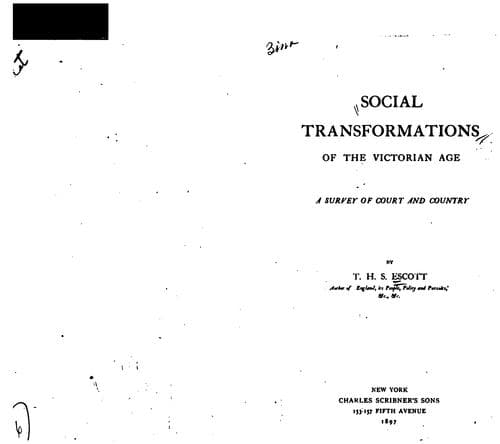
Social Transformations of the Victorian Age: A Survey of Court and CountryEscott, T. H. S. (Thomas Hay Sweet)
History
Social Transformations of the Victorian Age: A Survey of Court and Country
Escott, T. H. S. (Thomas Hay Sweet)
Great Britain -- Civilization -- 19th century; Great Britain -- Social life and customs -- 19th century
The reform in the system of officers' education which the Prince Consort
launched his eldest son has already lived to see practically
accomplished. At the beginning of the reign the average military officer
at his best was a keen sportsman or a well-bred London club-man; at his
worst, and as not very unfrequently witnessed, the original of him may be
recognised to-day in Thackeray's Sketches of Ensigns Rag and Famish;
before some Becky Sharpe of the period had taken them in charge, and had
developed them into Captains Rawdon Crawley, to become in due course
candidates for the Governorship of Coventry Island. The officer of to-day,
naval as well as military, is not less keen a sportsman, is as good a
shot, can take and hold a line of his own across country equally well. But
he is a soldier first, eager to add to his knowledge from the facts of
history, or from contemporary examples of professional achievement. There
are to-day no better read men than those who serve their Sovereign ashore
or afloat. The training of our sailors of whatever rank leaves perhaps
something to be wished for. Scientific seamanship, however, is not merely
an ideal, but a familiar experience. Jack Tars or flag officers,--the
school wherein respectively they are trained is, as Nelson himself was,
and wished to see his sailors, above all things scientific too.
The man-of-war's-man of to-day has educated himself so well from books,
with occasional hints from his commanding officer, as to be often a better
informed person than the average undergraduate or Admiralty clerk. To
speak now only of the soldier. It is not only that like the sailor he has
felt the intellectually quickening influences which are part of the
atmosphere of his epoch. The military officer of to-day has passed
through the curriculum which the Prince Consort was among the earliest to
mark out; he has already acquired nearly all that learning which thirty
years ago it was predicted would prove the ruin of the Service. Between
what he is and what he was, the contrast is not less great than between a
future Moltke and Corinthian Tom; yet has he not developed into the
spectacled professor with head too big for any busby to fit, to which some
looked forward should the British subaltern fail to model himself after
Albert Smith's medical student.
Public-domain text, read in full here on John Shaqi.
Reviews
Reviews
No reviews yet
Be the first to share your thoughts on this work.
Elsewhere in the archive
Join the Discussion
Join the discussion
Sign in to leave a comment or review.
Sign InorCreate an account