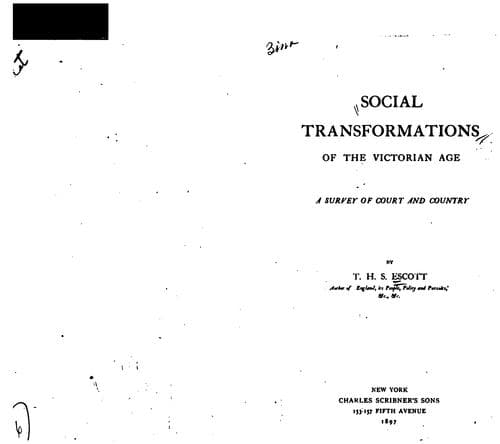
Social Transformations of the Victorian Age: A Survey of Court and CountryEscott, T. H. S. (Thomas Hay Sweet)
History
Social Transformations of the Victorian Age: A Survey of Court and Country
Escott, T. H. S. (Thomas Hay Sweet)
Great Britain -- Civilization -- 19th century; Great Britain -- Social life and customs -- 19th century
There have been later reforms than this in the professional education of
our sailors. Till between forty and fifty years ago men and boys entered
the navy without any previous training. In, or about 1855, all sailors
entered the service as boys chiefly from fifteen to sixteen and a half
years old. They now begin by passing from twelve to eighteen months on
board the training ship. Here they are instructed in seamanship and
gunnery. They thus bring with them to sea a practical knowledge of their
duties. The system which has given us a new race of naval officers dates
from nearly the same time as that which began to produce a fresh
generation of seamen. Before 1857, no regular system of training
midshipmen existed. All their knowledge was actually acquired afloat,
exactly as Captain Marryat describes. The large ships only were furnished
with regular naval instructors. Since the 'Britannia' was instituted in
1857, all midshipmen receive from fifteen months to two years education in
naval subjects and in mathematics. The educational term is not over when
the professional career begins. The course of study necessary before the
examination for Lieutenant can be passed has been greatly expanded.
Formerly acting mates were supposed to satisfy all educational tests for
Lieutenant in about three months. Now a year is occupied with these
studies; the qualifying standard for the pass examination is pitched far
higher than was ever known before.
The transformation undergone by our navy which strikes the eye most
forcibly is of course the replacement of the wooden walls by the floating
ironclad and the substitution of steam for wind-filled sails as the
propelling power of our fleet. A naval officer, Sir William Symonds,
instead of a member of the School of Naval Architecture, was appointed
Surveyor of the Navy; the first step towards improving ship construction
was taken. Almost on the eve of the Queen's accession, certainly during
all the earlier thirties, steamers 5 of which in all existed, were only
used to tow ships of the line in and out of harbour; or at the utmost for
a trip to Gibraltar or Malta. When Captain Charles Napier predicted that
steam would soon become to the navy what cavalry is to the army, and have
the post of honour, the prediction seemed impossible. The adoption of
steam was a very gradual and tentative process. First the 'Active,' a
46-gun frigate was fitted with paddles, but not as yet engines. The result
was progress at a maximum of from 2 to 3 knots an hour. Captain Napier
carried the experiment a little further; but in no case was steam yet
exclusively relied on for working the paddles. When Queen Victoria came to
the throne the navy included 5 steam paddle vessels. Each of them had
three masts furnished with sails. All were generically known as steam
sloops. The largest was 830 tons; the maximum of speed from 8 to 10 knots.
Larger steamers called steam frigates, from 1,200 to 1,800 tons were
Public-domain text, read in full here on John Shaqi.
Reviews
Reviews
No reviews yet
Be the first to share your thoughts on this work.
Elsewhere in the archive
Join the Discussion
Join the discussion
Sign in to leave a comment or review.
Sign InorCreate an account