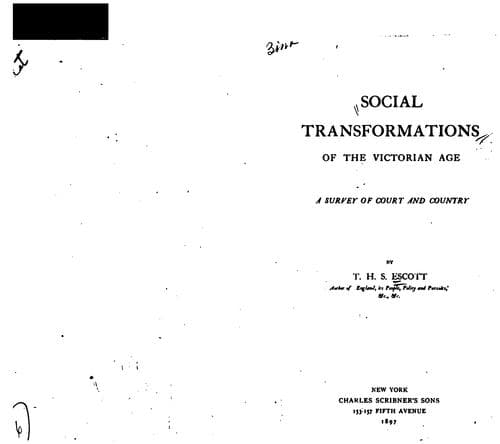
Social Transformations of the Victorian Age: A Survey of Court and CountryEscott, T. H. S. (Thomas Hay Sweet)
History
Social Transformations of the Victorian Age: A Survey of Court and Country
Escott, T. H. S. (Thomas Hay Sweet)
Great Britain -- Civilization -- 19th century; Great Britain -- Social life and customs -- 19th century
introduced soon after the reign began. They were first actively employed
at the bombardment of Acre in 1840, and notwithstanding their old lines of
construction, proved the usefulness of armed ships at sea against forts on
land. The Acre operations seem to have been important, as showing for the
first time the skill of Victorian seamen in gunnery and in the management
of the machinery of steam ships. Similarly, long before this only the
skill with which English ships were handled had overcome, in their
encounters with French, the faults of their design. The weight of metal
thrown by the largest guns on board these earlier craft, _e.g._ the
'Nelson,' was 2,750 lbs. Further steam progress was marked when, eight
years after the reign began, the 'Erebus' and 'Terror' in which Sir John
Franklin's expedition sailed for the Pole, were fitted with the screw.
As yet iron had not been employed on the present scale in ship
construction. Both in 1857 and 1858 larger ships than had yet been known,
the 'Niagara' first, the 'Orlando,' the 'Mersey,' afterwards, were built,
all, however, of wood. Long after steam was partially employed, sails were
retained. Even during our Black Sea and Baltic operations in Crimean days,
screw and paddle were still combined with canvas. Such success as our
fleet secured at this time was not promoted by the excellence of our naval
organization which according to Captain Eardley Wilmot, was not much
better than our military.[73] The first lesson as to the new mode of
motion by sea learnt from the naval operations in Crimean waters was
recognized by Kinglake and is confirmed by Captain Eardley Wilmot as being
that 'in regions where land and sea much intertwine, steam is stronger for
attack than for defence.'
The iron ships now almost as essential to the idea of a navy as steam
itself, had been tried for different purposes long before our Admiralty
adopted them; the material had been used, first in 1812 for canal barges,
secondly, a little later, for the mercantile marine. Iron was not employed
for our navy till the last days of William IV. The tragic fate of the
first iron ship, the 'Birkenhead,' may well have prejudiced both the
Department and the public against the new material.
Public-domain text, read in full here on John Shaqi.
Reviews
Reviews
No reviews yet
Be the first to share your thoughts on this work.
Elsewhere in the archive
Join the Discussion
Join the discussion
Sign in to leave a comment or review.
Sign InorCreate an account