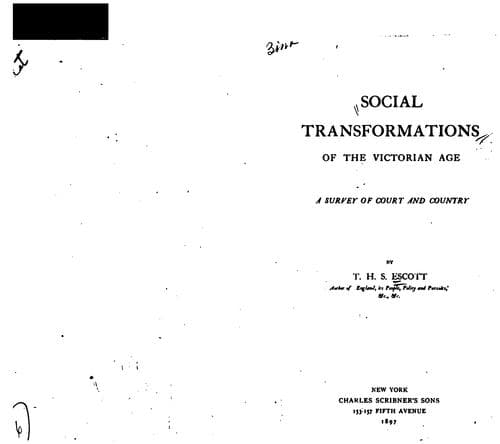
Social Transformations of the Victorian Age: A Survey of Court and CountryEscott, T. H. S. (Thomas Hay Sweet)
History
Social Transformations of the Victorian Age: A Survey of Court and Country
Escott, T. H. S. (Thomas Hay Sweet)
Great Britain -- Civilization -- 19th century; Great Britain -- Social life and customs -- 19th century
It is suggestively prophetic of the new era which in the next reign was to
open for letters, science and art in their relations to the English State,
that while the country had been preparing for a revolution peaceful but
complete in politics, there had assembled at York, September 29, 1831, a
company which prognosticated the coming revolution throughout the whole
region of popular thought and culture. The York meeting mustered less than
200. It was intended only to launch the programme of the society. 'To
point out the lines of direction in which the researches of science should
move, to state the problems to be solved, the data to be fixed, to assign
to every class of mind a definite task, to amend the laws relating to
patents, to agitate for a Government provision to encourage and reward
scientific research;'--these are the objects which Mr Harcourt enumerated
in the first official document of the body. As proof of the vitality of
the revolution which that Yorkshire company, less than 200 strong,
introduced, it is enough to mention Dr Rae's Arctic voyages of 1853-4, the
Challenger expedition of 1872, and the last Oxford University Commission
which at the instance of the first scientific Premier England has ever
known, Lord Salisbury, endowed scientific research as one of the estates
of the realm, and has done something more than relieve that seat of old
learning from the reproach of discouraging the newest sciences. Little
perhaps did the doctors of divinity, and classical professors, when, on
June 18, 1832, they welcomed the second senate of savants to its session
on the Isis, imagine themselves to be fostering a movement which would
partially oust from its emoluments and honours in their own Schools the
old learning, and give to the new not only professorships for its
teachers, but scholarships for the reward of its learners. As against the
York meeting in 1831 of not much more than 100, the Oxford meeting of the
Reform Act year attracted 700. In another twelvemonth the Cambridge
meeting of June 25, 1833, was attended by 900. The Edinburgh meeting of
September 8, 1834, mustered 1,298.
Public-domain text, read in full here on John Shaqi.
Reviews
Reviews
No reviews yet
Be the first to share your thoughts on this work.
Elsewhere in the archive
Join the Discussion
Join the discussion
Sign in to leave a comment or review.
Sign InorCreate an account