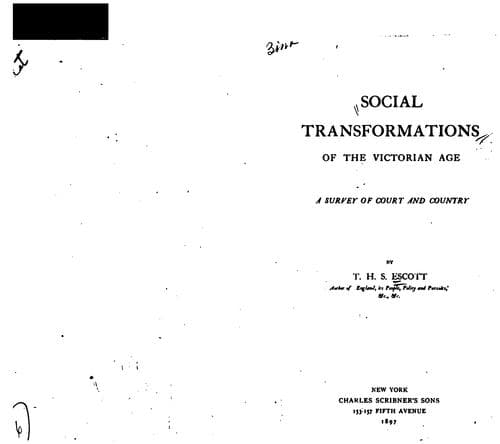
Social Transformations of the Victorian Age: A Survey of Court and CountryEscott, T. H. S. (Thomas Hay Sweet)
History
Social Transformations of the Victorian Age: A Survey of Court and Country
Escott, T. H. S. (Thomas Hay Sweet)
Great Britain -- Civilization -- 19th century; Great Britain -- Social life and customs -- 19th century
The Victorian Court had begun to encourage science before Darwin's great
book was published. In 1847 the Prince Consort became Chancellor of the
University of Cambridge, and in this capacity he was naturally brought
into official and friendly relations with Dr Whewell, then Master of
Trinity, as well as with other English leaders of scientific thought. The
growing success of the British Association after its inaugural congress
had been held, is not unjustly connected with the Prince's name. The idea
of an annual parliament of learning was, like that of the Great Exhibition
itself, not of English origin. Even in Germany, where the first trial of
it had been made, prosperity had been gradual. At Halle, Frankfort,
Dresden, and Munich, notwithstanding the personal distinction of its chief
promoter Professor Oken, and its encouragement by many of the enlightened
Kinglets who then divided the rule of the Fatherland, during the second
decade of the century when the enterprise began, its most noticeable
meeting does not seem to have numbered more than from 200 to 400. At
Leipsic in 1822, the attendance was barely two score; six years later in
Berlin, it amounted to 464. Before that assemblage probably had much
impressed the young Prince Albert, it had stimulated the most
distinguished representatives of scientific thought in England. Sir David
Brewster, Sir John Herschel, Sir Humphry Davy based, upon the German
example, an appeal to the English Government. The decline of arts and
science in this country was attributed to their total neglect by the
State, to the exclusion of men eminent in either of these departments from
the titular decorations of the country, and to the heavy exactions from
scientific inventors imposed by the fees payable under the patent law.
More than two or three decades of the Victorian age had passed before art,
science, and letters began to receive the State recognition now firmly
acknowledged as their due. Both Bulwer Lytton and Macaulay had served in
Parliament or in office fifteen years before they were ennobled.[77]
Tennyson was the first English poet raised to the peerage who knew no
politics save those of patriotism; to the same epoch, too, belongs a like
honour bestowed upon three men of science at successive intervals:--now a
physician, Playfair, now the physicist, Lord Kelvin, and again the latest,
and to not a few the most welcome and significant of all, the inventor of
the antiseptic treatment which has saved so many lives and limbs, who will
henceforth be known as Lord Lister.
Public-domain text, read in full here on John Shaqi.
Reviews
Reviews
No reviews yet
Be the first to share your thoughts on this work.
Elsewhere in the archive
Join the Discussion
Join the discussion
Sign in to leave a comment or review.
Sign InorCreate an account