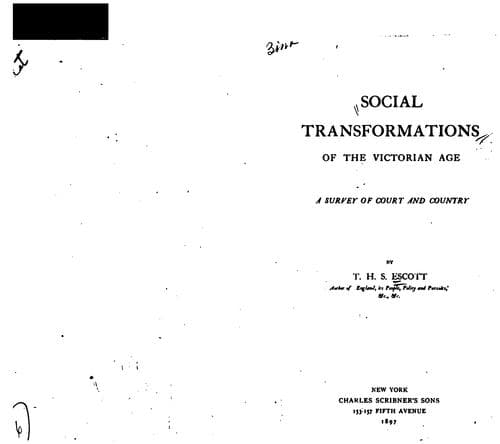
Social Transformations of the Victorian Age: A Survey of Court and CountryEscott, T. H. S. (Thomas Hay Sweet)
History
Social Transformations of the Victorian Age: A Survey of Court and Country
Escott, T. H. S. (Thomas Hay Sweet)
Great Britain -- Civilization -- 19th century; Great Britain -- Social life and customs -- 19th century
Even this pronouncement seems to have been anticipated. A physicist less
famous than Huxley, Schwann, some half a century before Huxley's day, is
said to have been the first to criticize the abiogenesis doctrine as
supported by no sufficient evidence. The tendency towards unity in
multiplicity declared by the old Greek thinkers to characterize all true
science marked the doctrines of the correlation of force as well as of the
conservation of energy, both of them connected with this age. It was also
inherent in the theory of evolution as explained by Charles Darwin in
1859, 28 years, that is, after the British Association for the first time
met. Even the great Kentish physicist of our day was not entirely the
first in the field with the discovery that was to transform the whole
region of thought. Early in the last century De Maillet had applied the
principle of the survival of the fittest to the world of human life. On
the eve of the present century Charles Darwin's ancestor, Erasmus, as well
as German philosophers still more famous, elaborated with more ability
and knowledge the same idea, which also underlay the discussions between
the French Academicians, Cuvier and St Hilaire. However the ground may
have been prepared for him, so far as any single man can be said to have
discovered any great idea, Charles Darwin must be accounted the author of
the theory of evolution as it is now understood.
Whewell's survey of the inductive sciences at the beginning of the reign
dimly forecasts some discoveries which have since been verified. It
contains no word prophetic of the doctrine by which, in the countless
possibilities of its application, every branch of science in little more
than a quarter of a century was potentially if not actually to be
transformed. The eve of the sixtieth anniversary of the Queen's accession
has witnessed the completion by Mr Herbert Spencer of the monumental
treatise that applies the doctrines of Darwin to subjects that Darwin had
not specially studied, perhaps with results which Darwin himself had not
entirely foreseen. Whether a reaction against Darwinism has already, as
some think, set in; how far, and with what consequences, that movement may
go, are as yet only matters of speculation.
Public-domain text, read in full here on John Shaqi.
Reviews
Reviews
No reviews yet
Be the first to share your thoughts on this work.
Elsewhere in the archive
Join the Discussion
Join the discussion
Sign in to leave a comment or review.
Sign InorCreate an account