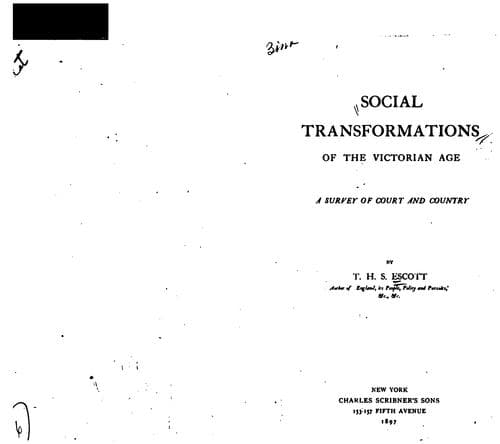
Social Transformations of the Victorian Age: A Survey of Court and CountryEscott, T. H. S. (Thomas Hay Sweet)
History
Social Transformations of the Victorian Age: A Survey of Court and Country
Escott, T. H. S. (Thomas Hay Sweet)
Great Britain -- Civilization -- 19th century; Great Britain -- Social life and customs -- 19th century
The exploration of the Italian soil has caused many chapters of Roman
history to be rewritten more in accordance with the older traditions than
with the newer learning. Like processes near the sites of Babylon and
Nineveh have done much to vindicate the authors of the Pentateuch as
chroniclers of fact; and have even created a reaction in favour of the
Mosaic cosmogony, and the sacred narrative of the Deluge. Evolution as a
philosophy is not altogether rejected by physicists of orthodoxy so
unimpeachable as Mr St. George Mivart. More lately it has been discovered
that an Anglican divine may keep an open mind on the subject of Darwinism
and yet be made Archbishop of Canterbury. To the unlearned English vulgar
the question is whether the visible universe and its inhabitants are more
likely to have developed themselves by a series of indescribable processes
than to have developed, as the Scriptural tradition has been interpreted
as teaching, by a Power external to them and directing every stage of
their progress. If it be said that evolution is the method in which that
superhuman Power who is behind and above all often chooses to act, there
is no reason why the occupant of Lambeth should not be as good an
evolutionist as the scientific investigator whose nearest country
neighbour at Down, Sir John Lubbock, appropriately presided over the
Jubilee meeting of the British Association at York.
The transformations effected in other departments of physical study during
our age are not less remarkable. Many of them have been appreciably
assisted by the social intercourse of mind with mind which the British
Association has so signally promoted. Lyell's _Principles of Geology_ was
published in pre-Association days and seven years before the Victorian age
began. Its influence was in the same direction as that of Darwin; it
suggested, that is, the enquiry why the natural processes that are said to
explain the globe we inhabit should not explain also the presence of man
upon it. Biology and anthropology, the two studies which have most been
promoted by the Darwinian doctrine, can consequently be pronounced with
truth the creations of the present age. As far back as Elizabethan times,
electrical phenomena had been systematically studied. Many of these
manifestations, however, especially their relations with heat and light,
as well as most of their adaptations to the offices of daily life, belong
to the era that opened in 1837.
Photography of course was an unknown art in pre-Victorian days. Even when
its predecessor, the Daguerreotype, discovered in 1839, had been
considerably improved upon, it still remained a contrivance rather for
distorting the human features than for faithfully reproducing them as
photography does upon glass or paper, and with the addition of natural
colours as photography now bids fair soon to have done.
Public-domain text, read in full here on John Shaqi.
Reviews
Reviews
No reviews yet
Be the first to share your thoughts on this work.
Elsewhere in the archive
Join the Discussion
Join the discussion
Sign in to leave a comment or review.
Sign InorCreate an account