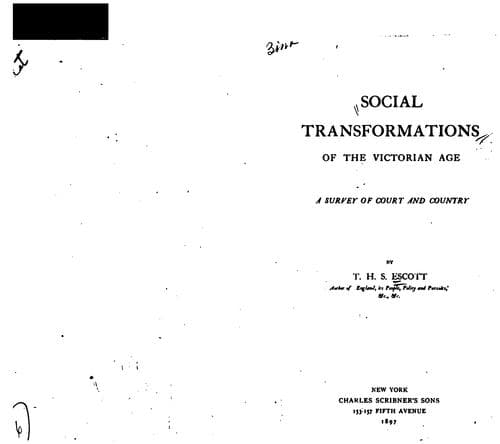
Social Transformations of the Victorian Age: A Survey of Court and CountryEscott, T. H. S. (Thomas Hay Sweet)
History
Social Transformations of the Victorian Age: A Survey of Court and Country
Escott, T. H. S. (Thomas Hay Sweet)
Great Britain -- Civilization -- 19th century; Great Britain -- Social life and customs -- 19th century
The organization and the educational machinery of music have now, in the
opinion of those competent judges to whom the writer of these lines is
indebted, reached a point beyond which further development is neither
necessary nor desirable. Production and execution leave perhaps little to
be wished for. Appreciation, however, of musical excellence is not
universally proportionate to musical activity. Audiences more
intelligently critical and better trained are apparently the chief
_desiderata_, if composers and performers are to rise above mediocrity.
Instruction in the art now spoken of has, of course, shared in the
advantages incidental to the transformation of London from an insular into
a cosmopolitan capital. As a result, the best teachers from all countries
are available for the London learner.
Nor in this respect does England to-day, as thirty years ago it did,
compare disadvantageously with Leipsic, Paris, Berlin, Stuttgardt. There
seems however reason to fear that, like Gwendolen Harleth in _Daniel
Deronda_ before Klesmer, we fail in that important and indefinable
quality, style. The best critics complain that, when a student has been
through the regular course here, and has perhaps become a first rate
technical musician, he seldom seems to get any further; he never, in other
words, develops any individuality. To some extent this result follows the
collective teaching of all academies. The area of level mediocrity is,
however, it may be feared, larger here than in France or Germany. There is
more of delicacy and daintiness in the French student; there is more of
individual expansion and thoughtfulness in the German. Both are trained in
academies. The quicker intuition and more intelligent appreciation of
French and German audiences are in the opinion of unprejudiced critics
attributed to this cause. Hence the expert, if consulted by an English
student, probably would advise him to go abroad for a year or two when
his technical course has been finished in England. Unfortunately the
advice too often resembles that of a medical man who might prescribe a
generous diet and a glass of port wine to an invalid labourer, earning
less than £1 a week.
In respect of education, cheapness and free scholarships seem to have been
carried at least as far as is conducive to the real interest of learners
in this country. A reform, favoured by many good judges, is to make
payment for teaching universal with a few exceptions; then to give to
students of promise an allowance sufficient to enable them to go abroad
and complete their education. As it is, some risk is run of gratuitously
training mediocrities, launching them on professional careers which can
only land them in disappointment and poverty.
Public-domain text, read in full here on John Shaqi.
Reviews
Reviews
No reviews yet
Be the first to share your thoughts on this work.
Elsewhere in the archive
Join the Discussion
Join the discussion
Sign in to leave a comment or review.
Sign InorCreate an account