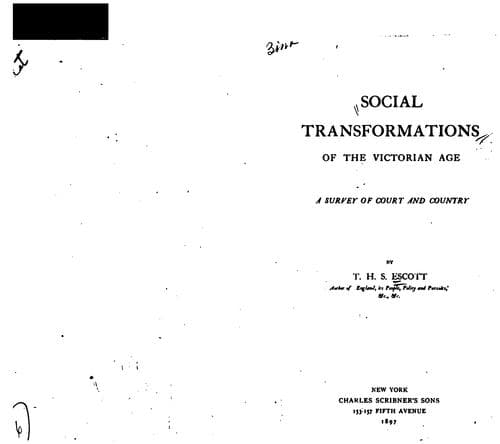
Social Transformations of the Victorian Age: A Survey of Court and CountryEscott, T. H. S. (Thomas Hay Sweet)
History
Social Transformations of the Victorian Age: A Survey of Court and Country
Escott, T. H. S. (Thomas Hay Sweet)
Great Britain -- Civilization -- 19th century; Great Britain -- Social life and customs -- 19th century
The late Prince Consort, though the most highly placed, is only one of
several individuals whose personal influence has conspicuously encouraged
the growth and the gratification of a musical taste more or less
cultivated. The discussion which agitated English taste in the eighteenth
century as to the merits of German and other music is summed up in a
familiar epigram as the difference between tweedledum and tweedledee:--
Some say, compared to Bononcini,
That Mynheer Handel's but a ninny;
Others aver that he to Handel
Is scarcely fit to hold a candle.
The commanding genius of the great German composer is enough to account
for the traditional complaint that native genius in England has been
eclipsed by foreign products. The Elector of Hanover had recognized
Handel's genius before he became George I. of England, but began his reign
by showing little favour to the composer, who had absented himself without
leave from his duties at the Electoral Court. Already in Queen Anne's
reign Handel's _Te Deum_ had celebrated in St Paul's Cathedral the
conclusion of the Peace of Utrecht. It was not till after his _Water
Music_ had procured his restoration to favour that the new English monarch
took him back into his service. Gradually, however, till in 1741 it was
confirmed by the _Messiah_ produced in Dublin and by his operas in London,
the triumph of the German over the Italian school thus advanced. Neither
then nor later did it involve neglect of the great English composer of the
seventeenth century, our own Henry Purcell,[78] organist at Westminster
Abbey at eighteen years of age, and author of a greater number of songs,
anthems, operas, glees and cantatas, at once famous and popular, than
probably any other musician whom England has produced. Felix Mendelssohn
of Hamburg, not less precocious than our own Purcell, also at eighteen
produced an opera. His personal influence in England was scarcely less
great than that of Handel, and of course tended towards the further
popularization of Teutonic art: he lived on terms of intimate friendship
during his different sojourns in this country with English musicians. The
popular and accomplished pianoforte improvisatore, John Parry, who was
familiar to the English public of this age from his connection with the
German-Reed company, 1860-9, the forerunner of the Corney Grain and Arthur
Cecil of a later day, might almost be called Mendelssohn's pupil. By
Mendelssohn, Parry was first encouraged to adopt music as a profession;
the present writer well remembers how he heard from John Parry himself the
account of Mendelssohn's listening during half a winter night to the piano
improvisations devised by the versatile genius of the then young man.
Public-domain text, read in full here on John Shaqi.
Reviews
Reviews
No reviews yet
Be the first to share your thoughts on this work.
Elsewhere in the archive
Join the Discussion
Join the discussion
Sign in to leave a comment or review.
Sign InorCreate an account