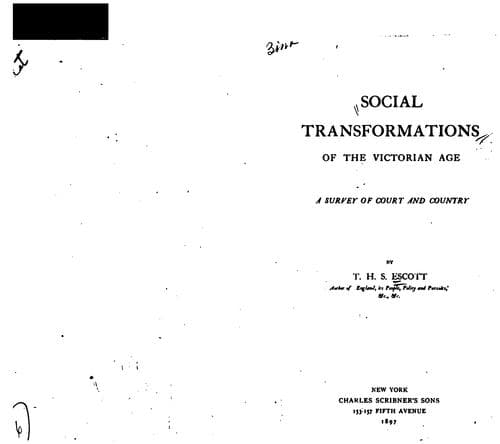
Social Transformations of the Victorian Age: A Survey of Court and CountryEscott, T. H. S. (Thomas Hay Sweet)
History
Social Transformations of the Victorian Age: A Survey of Court and Country
Escott, T. H. S. (Thomas Hay Sweet)
Great Britain -- Civilization -- 19th century; Great Britain -- Social life and customs -- 19th century
Sir Edwin Landseer, elected R.A. 1830, it may be said, years before the
transformation now spoken of, was welcome in any house whose threshold he
pleased to cross. His was rather the exception which proved the rule, and
for these reasons; he flourished most just when Court patronage was making
the Scotch Highlands fashionable; he was the painter of hounds, horses,
animals themselves so eminently aristocratic that no Englishman with any
pretensions to social breeding could affect disregard for them, or for
their reproducer in art without losing caste. Hence it is that while
fifty years since, the Clive Newcomes who took to painting were spoken of
by their families in a low voice much as if they had taken to drink, the
painter of repute to-day who chose to receive pupils[83] would have no
more difficulty in filling his studio twice over, than a fashionable
crammer for the army or Civil Service in filling his lecture room. As a
fact it is not in the private studios of great artists that the Royal
Academician of the future, unlike the intending exhibitor in the Parisian
salon, is to-day generally trained. Sass had a rival, or a professional
descendant, in the father of a clever versifier H. S. Leigh. Since that
day, English artists have generally learnt their craft in the Royal
Academy, or the Slade or other schools of England, or in foreign ateliers.
These have transformed the surface of Victorian England. The same
organization of art teaching, which is to-day at the disposal of all is
said to have discouraged the development of individuality. Where genius
exists, it is not very likely to be strangled by the conventions of a
public school, nor to be prevented from exchanging State teachers for
those whom native inspiration prompts it to prefer.
Public-domain text, read in full here on John Shaqi.
Reviews
Reviews
No reviews yet
Be the first to share your thoughts on this work.
Elsewhere in the archive
Join the Discussion
Join the discussion
Sign in to leave a comment or review.
Sign InorCreate an account