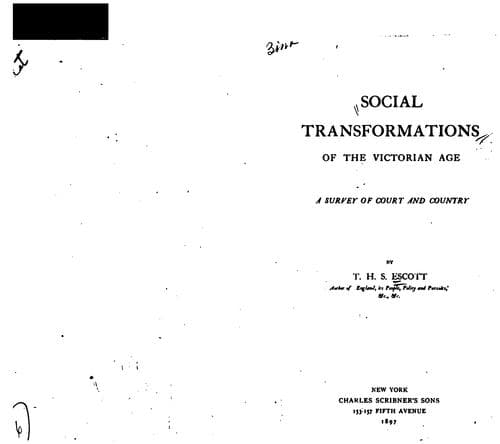
Social Transformations of the Victorian Age: A Survey of Court and CountryEscott, T. H. S. (Thomas Hay Sweet)
History
Social Transformations of the Victorian Age: A Survey of Court and Country
Escott, T. H. S. (Thomas Hay Sweet)
Great Britain -- Civilization -- 19th century; Great Britain -- Social life and customs -- 19th century
These were still the days when art and artists had not migrated from the
gloomy studios of unfashionable Bloomsbury to the gleaming palaces of
modish Kensington. Sir Charles Eastlake's predecessor had been Sir Martin
Archer Shee, who, very faintly disguised, appears in Thackeray's Mr Smee
in _The Newcomes_. Gandish, the unappreciated genius of the palette at
whose school, on Mr Smee's advice Clive Newcome is placed, is not a
caricature at all of the most serviceable art teacher of that period whose
real name was Sass and who counted among his pupils John Everett Millais.
What has taken place since then is that in the smiles of popular favour,
Thackeray's Gandish has blossomed into the Mr Gaston Phoebus of Lord
Beaconsfield's _Lothair_. Colonel Newcome thought it a condescension to
ask the painter of 'Boadishia' to dinner. That artist's later and
transformed self would have resented an invitation at short notice as an
impertinence; he would have bluntly excused himself on the plea of being
pre-engaged to the Prime Minister,[82] the Heir Apparent, or to Windsor
three months ago. The social prejudice, confined to a small section of the
upper middle class, against the studio which lingered so long and so
unintelligently in England is easily explained. It is identical in its
origin with an equally unreasoning and antiquated feeling against
doctors, singers and players. This superstition had disappeared in the
days of Sir Henry Holland who, half a century ago was a welcome and
honoured guest at the most exclusive houses; under men like Sir James
Paget and Sir Richard Quain it has long since ceased even to be a memory.
In each of these cases money is regarded as passing directly between the
patronizing public and the employed professional. The purse is opened at
the door of the theatre, the concert hall, or in the consulting room of
the physician. That the payment is in the other cases as real though not
as sensibly direct is ignored. The terms on which Sir Charles Eastlake was
a visitor at the Victorian Court are those that have marked the subsequent
relations of his successors with the Crown. The intellectual influences of
a whole school of intelligent and highly educated critics following as
nearly as they could the example of Mr Ruskin, has shed a dignity on the
painter's calling that could not have resulted from material prosperity or
the favour of high place alone.
Public-domain text, read in full here on John Shaqi.
Reviews
Reviews
No reviews yet
Be the first to share your thoughts on this work.
Elsewhere in the archive
Join the Discussion
Join the discussion
Sign in to leave a comment or review.
Sign InorCreate an account