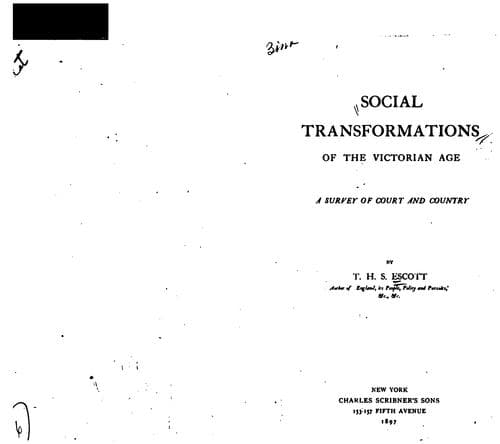
Social Transformations of the Victorian Age: A Survey of Court and CountryEscott, T. H. S. (Thomas Hay Sweet)
History
Social Transformations of the Victorian Age: A Survey of Court and Country
Escott, T. H. S. (Thomas Hay Sweet)
Great Britain -- Civilization -- 19th century; Great Britain -- Social life and customs -- 19th century
In 1841 Thomas Carlyle sighed for the day when a 'people's library' should
be as much a part of every town as Her Majesty's jail, or in his own grim
words--Her Majesty's gallows. The reign was still young when the
philosopher's vision began to take shape and substance. In every centre of
population from the Tyne to the Thames, from the Thames to the Tamar, a
place where, without payment, upon no other conditions save those of
reasonably clean hands, and silence, the working man is as well off for
newspapers and books as a Bishop at the Athenæum Club, has changed the
Victorian landscape. These buildings, comely to look at, comfortable to
enter, have competed with the later board schools in transforming the
appearance of London suburb and provincial town. Where Knightsbridge
merges into Chelsea first, and Fulham afterwards, there, during the early
days of the reign, desolate fields and miry ways used to stretch their
unlovely length. After dusk there were few lamps to light; the roads were
not more safe than Hounslow Heath had been some generations earlier.
To-day this district is covered by a mass of buildings in red brick or
stone, of aspect rather more academic than the new quarter of Victorian
Oxford. Among these are the free libraries, built, partly out of the
public rates, partly out of private funds. If it chance to be Saturday
night, hundreds of working men, decently clad, with parcels under their
arms will be seen passing to and fro near these buildings. They are not
going to the public house. The packages they carry do not imply a
negotiation with the pawnbroker. The men are, in fact, returning to the
library the books which, taken out some days earlier, have given them
their reading during the week after the day's work has been done. Certain
processes supplementary to these studies have still to be performed. Even
in our age of improvement, the reference library kept by an artizan at his
fireside is not extensive. Nothing quickens the intellectual appetite
like its earliest gratification. As our student has travelled through the
volumes which have occupied him, he has become aware of allusions for the
full understanding of which fresh information is required. He has,
therefore, while going along, made notes of points to look up. This,
therefore, is one of his errands to-night.
Public-domain text, read in full here on John Shaqi.
Reviews
Reviews
No reviews yet
Be the first to share your thoughts on this work.
Elsewhere in the archive
Join the Discussion
Join the discussion
Sign in to leave a comment or review.
Sign InorCreate an account