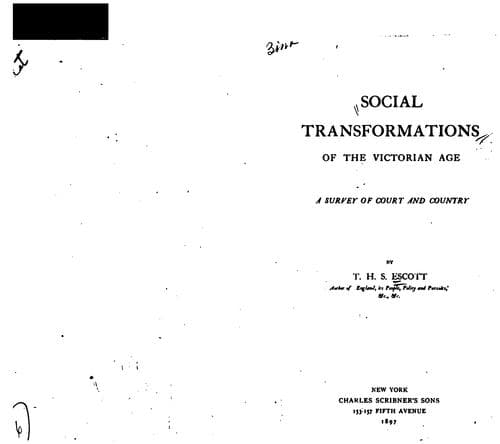
Social Transformations of the Victorian Age: A Survey of Court and CountryEscott, T. H. S. (Thomas Hay Sweet)
History
Social Transformations of the Victorian Age: A Survey of Court and Country
Escott, T. H. S. (Thomas Hay Sweet)
Great Britain -- Civilization -- 19th century; Great Britain -- Social life and customs -- 19th century
No professional visitor to the British Museum sets more systematically to
work than our day labourer in the Fulham or Pimlico district. Before his
visit this evening to the place of silence and of books he has, perhaps,
had recourse to a member of the University Settlement in his
neighbourhood, or possibly even to his own employer if the employer
happens to be better read than the employed. The local librarian presently
to be consulted needs to combine patience and method with something like
omniscience. The note book is produced by our working man in which the
points for enquiry have been jotted down. In a few minutes the official
has placed the researcher on the right track. Before his studies are ended
that night he will have hunted up facts and figures enough to furnish
forth a leading article for a journalist, or a speech in Committee for a
Member of Parliament.
Not only in the industrial suburbs of the capital, but throughout the
Kingdom, this is the sort of thing which takes place at least on one
evening in every week. It is one among the many agencies which, nowadays,
make the humblest reader so terrible a critic, and which cause a working
man's meeting to be not less intolerant of mere rhetoric than the House
of Commons itself.
Like everything else which during our age has been brought towards
perfection, the free library movement existed among us in germ from the
earliest days, before indeed the books themselves were known. When
Lancashire monasteries had ceased to be gratuitous places of literary
study, their manuscripts and parchments were housed in the Chetham
Library, with its old oriel windows at Manchester; in the Guildhall
Library at London, certainly coeval with Whittington; in the libraries of
Bristol or Liverpool which compete with London in antiquity, and with
which the Protector Somerset is said to have made somewhat too free.
The patronymic of the man who was the father of the free library as it is
known in England to-day is preserved in the second name of Mr Gladstone.
Mr Ewart belonged to an old Kirkcudbright family. He had been at Eton with
Dr Pusey and Speaker Denison. In the spring of 1843 he obtained a
Committee of the House of Commons to enquire into the conditions of
popular reading throughout the United Kingdom. Disraeli, Monckton Milnes,
Cardwell, Kershaw, were among the more famous names that the Committee
included. Less than ten years after this, the Ewart Act, based on the
Committee report was the law of the land.
In the early autumn of 1852, the new legislation was celebrated in a very
practical manner by the opening of the free library at Manchester; the
town which had been the birthplace of the movement.
Public-domain text, read in full here on John Shaqi.
Reviews
Reviews
No reviews yet
Be the first to share your thoughts on this work.
Elsewhere in the archive
Join the Discussion
Join the discussion
Sign in to leave a comment or review.
Sign InorCreate an account