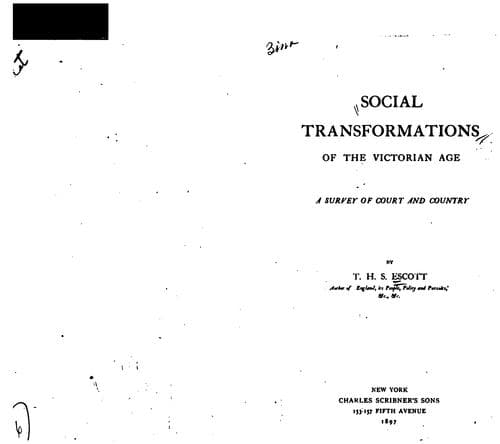
Social Transformations of the Victorian Age: A Survey of Court and CountryEscott, T. H. S. (Thomas Hay Sweet)
History
Social Transformations of the Victorian Age: A Survey of Court and Country
Escott, T. H. S. (Thomas Hay Sweet)
Great Britain -- Civilization -- 19th century; Great Britain -- Social life and customs -- 19th century
It is not only what are called the industrial classes whose literary
resources have been expanded and transformed during the Victorian age.
Libraries for a different class of readers have of late years increased
throughout the Kingdom, in the provinces not less than in the capital.
Mudie's is, in the most literal sense of the epithet, a national agency.
Its headquarters are in London. There is no town or village book club in
the country, which is not fed from its metropolitan shelves. Mudie's
Library was founded by the late C. E. Mudie, in 1842, two years after the
St James's Square London Library. If light literature were alone in
demand, this library would not flourish as during more than half a century
it has done. Without it, many of the candidates for the Indian, the Home
Civil Services and other such examinations would be unable to get up their
books. A theologian like Canon Liddon turns new light on old truths. A
pious and picturesque impressionist like Dean Arthur Stanley presents the
scenes and incidents of sacred story as he has himself seen or imagined
them. A Darwin propounds a fresh theory for the origin of life; a Froude
rehabilitates a Tudor; a Freeman refutes a Froude; a Livingstone explores
a Dark Continent; a Stanley recovers a reluctant Livingstone or an
indignant Emin. A Green illustrates the growth of an English people; a
Lecky supplements the work of a Buckle or makes the eighteenth century
real as the nineteenth.
Mudie's is the channel through which these streams of culture are conveyed
to the majority of English readers; for, highly educated as the Victorian
age may be, it is with books that its economies begin To buy volumes that
can be borrowed or hired, is accounted wanton extravagance. A work which
requires more study, which holds public attention longer than a novel,
must obviously be most profitable to the circulating librarian. Nor would
self-interest let him be a distributor of fiction alone or even primarily.
The increase of novel readers as of novel writers is indeed the great
literary feature of the day. Not less characteristic of the time are the
new periodicals which have created a fresh public for themselves. The
sixpenny magazines count their circulation by millions, and are borrowed
from the library as well as bought by their readers. But it is the
standard works, as shown by the instances already specified that give to
Mudie's its deserved epithet of 'Select.'
Public-domain text, read in full here on John Shaqi.
Reviews
Reviews
No reviews yet
Be the first to share your thoughts on this work.
Elsewhere in the archive
Join the Discussion
Join the discussion
Sign in to leave a comment or review.
Sign InorCreate an account