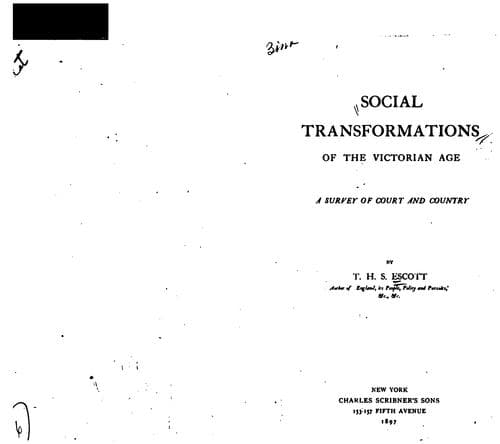
Social Transformations of the Victorian Age: A Survey of Court and CountryEscott, T. H. S. (Thomas Hay Sweet)
History
Social Transformations of the Victorian Age: A Survey of Court and Country
Escott, T. H. S. (Thomas Hay Sweet)
Great Britain -- Civilization -- 19th century; Great Britain -- Social life and customs -- 19th century
An objection is sometimes raised against the multiplication of free
libraries on the ground that they promote exclusively the perusal of the
most worthless fiction among the class least likely to be proof against
the social dangers of this class of writing. No novel, perhaps, is so
entirely mischievous as not to be preferable to the occupations from which
for a few hours, it may withdraw the illiterate reader. In truth however a
very careful examination of the facts by enquiries made at representative
free libraries throughout the country justify the statement that novels
form a stepping stone to books of a more seriously improving kind.
The same statistics show the demand for fiction already to be on the
decrease. Thus, in the case of the Newcastle-on-Tyne library; during a
recent twelvemonth, of the books issued to readers 65·69 were fiction. The
next year the proportion was 64·28. A year later it was 61·81. In 1896 the
figures were 55·22. The latest enquiries show this decline in the demand
for fiction to be steadily going forward. Further, the category of fiction
is stretched by free libraries to include not only the coloured paper
boards containing the latest sensational romance of the day, but all the
masterpieces of Fielding, nearly all the writings of Defoe, the _Arcadia_
of Sir Philip Sidney, the _Tristram Shandy_ of Lawrence Sterne, the _Don
Quixote_ of Cervantes, and the Dialogues of Lucian.
The remarkably elastic connotation with which the word fiction is thus
invested, may make one doubt whether a case might not be established even
for novel reading. As a fact the works most in demand at any typical
London library, _e.g._, that of Chelsea, are not novels at all. Here the
favourites seem to be Herbert Spencer's _First Principles_, thrice asked
for on the day this library was visited, his _Ecclesiastical
Institutions_, twice asked for. Aristotle's _Ethics_, the works of
Spinoza, Martineau's _Types of Ethical Theory_, Adam Smith's _Wealth of
Nations_, J. S. Mill's _Logic_, Professor Sayce's _Vindications of
Revealed Religion by the Light of Ancient Monuments_, all Sir Charles
Dilke's works of travel, Carlyle, Froude; _Cassell's Popular Educator_,
Todhunter's _Euclid_ are in greater demand than any fictions. However many
copies of these there might be, none, it is thought, would be often out of
hand.
Public-domain text, read in full here on John Shaqi.
Reviews
Reviews
No reviews yet
Be the first to share your thoughts on this work.
Elsewhere in the archive
Join the Discussion
Join the discussion
Sign in to leave a comment or review.
Sign InorCreate an account