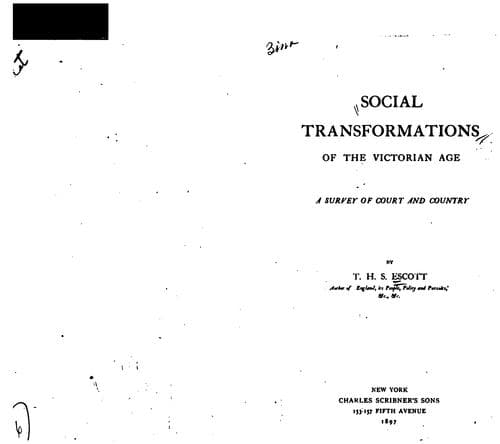
Social Transformations of the Victorian Age: A Survey of Court and CountryEscott, T. H. S. (Thomas Hay Sweet)
History
Social Transformations of the Victorian Age: A Survey of Court and Country
Escott, T. H. S. (Thomas Hay Sweet)
Great Britain -- Civilization -- 19th century; Great Britain -- Social life and customs -- 19th century
As has been already seen, in the theory and practice of the culture now
popularized in England, there is a growing tendency on the part of science
and art to trench upon the ground formerly occupied by literature. The
fashionable vocabulary of culture is itself an instance of this. Metaphors
from the palette, the scalpel, the crucible, the retort, are applied to
indicate the commonest and oldest literary phenomena. Or we hear of loaded
epithets, of dynamic diction, of sonatas in sentences, of fugues in
periods, and of new stratifications in style. Amid all our improvements we
are a little mixed, and have still to decide where the province of the
writer ends and that of his brother in some other art begins. This is a
transient, as it is a transitional phase. It may perhaps confuse posterity
which will scarcely recognize as the same language the lectures of Sir
Joshua Reynolds, the orations of Lord Leighton, the art criticisms of
Steele or Addison in _The Spectator_, of Walter H. Pater, of J. A.
Symonds, in _The Cornhill Magazine_, or one of the monthly Reviews.
The survey of the agencies now at work upon different social levels, shows
that even thus the education which comes of reading, competes at some
disadvantage with the instruction that is the result of lectures in class
rooms, of demonstrations in scientific 'theatres,' of days and nights
spent in museums of sculpture or in galleries of paintings.
During the second or third decades of the present reign, the literary
system of the country, as shown in the introductory chapter to this work,
was dominated by the presence of a few illustrious men, who naturally
became models for imitation to a host of workers. During their lives,
Dickens and Thackeray both founded schools. The former was, through the
weekly magazines he edited, the founder of newspaper descriptive writing,
especially of the picturesque Parliamentary narrative recently brought to
so high a point of perfection by clever writers now alive. The entire
company of satirical essayists in the weekly press, was first inspired by
Thackeray. Each master was surrounded by personal admirers and literary
imitators in a degree unapproached by any of his contemporaries or
successors. The author of _The Newcomes_ was outlived[91] by the
accomplished writer of that series which began with _Pelham_ in 1828 and
neared its end with _The Parisians_ almost fifty years later.
Public-domain text, read in full here on John Shaqi.
Reviews
Reviews
No reviews yet
Be the first to share your thoughts on this work.
Elsewhere in the archive
Join the Discussion
Join the discussion
Sign in to leave a comment or review.
Sign InorCreate an account