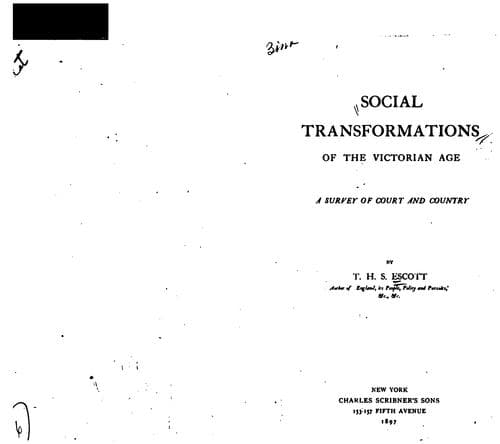
Social Transformations of the Victorian Age: A Survey of Court and CountryEscott, T. H. S. (Thomas Hay Sweet)
History
Social Transformations of the Victorian Age: A Survey of Court and Country
Escott, T. H. S. (Thomas Hay Sweet)
Great Britain -- Civilization -- 19th century; Great Britain -- Social life and customs -- 19th century
While the anniversaries of the Queen's accession were few in number,
Lytton by the side of Dickens, as a popular master of the pen, filled
something like the place which Thackeray had occupied before him. During
most of his time, another man of letters belonging like Lytton to the
titled classes divided with Lytton the social patronage of literary
beginners. No man of his day did so much as Lytton to help younger men
with the booksellers, as in his old-fashioned phrase he was apt to call
the publishers. He had indeed a rival or a colleague in these good offices
in Lord Stanhope, then Lord Mahon, the historian, as also in Mr Monckton
Milnes, afterwards Lord Houghton, the timely friend of Coventry Patmore,
and the rescuer from great troubles of a forgotten but deserving poet
David Gray.
When as yet journalism as a profession was not fully organized, and young
authors still looked first to the pillars of Paternoster Row, an
introduction to Lord Lytton or to Lord Stanhope was the surest stepping
stone to print. In this way Antonio Gallenga, then an obscure refugee,
with associations of the dagger and bowl about him, having won the good
word of Lytton, found a publisher for his _History of Piedmont_. This in
its turn opened to him the office of the _Times_. Here he made his name
not only as among the most brilliant, best informed and versatile of
newspaper writers but, together with William Howard Russell, as a founder
of that school of graphic newspaper narrative since represented by
Archibald Forbes, Edward Dicey, B. H. Becker, G. A. Henty, George Augustus
Sala, and John O'Shea.
The development of the press has changed most of the conditions of
literary life. For very many Englishmen of all classes, the periodical,
daily, weekly, or monthly, is practically an exclusive synonym for
literature itself. This fact of course has reacted upon the whole class of
professional writers. The most commercially successful of men and women of
letters are, as, since the days of Sir Walter Scott, they have been,
authors of some novel which hits the taste of the moment, and fixes the
interest of the town. When George Eliot wedded in her writings the
artistic to the scientific spirit, she invented a combination unknown till
then; she opened a gold mine for herself and the more dexterous of her
disciples. Dickens and Thackeray both realized high prices for the labour
of their pen. Wilkie Collins and Charles Reade were not far behind. But
the men of this class were either original creators of literary types that
will take their place with the characters of Shakespeare, and Cervantes,
or else were masters in the manufacture of exciting and dramatic plots.
Public-domain text, read in full here on John Shaqi.
Reviews
Reviews
No reviews yet
Be the first to share your thoughts on this work.
Elsewhere in the archive
Join the Discussion
Join the discussion
Sign in to leave a comment or review.
Sign InorCreate an account